


The Universe’s Heavyweights
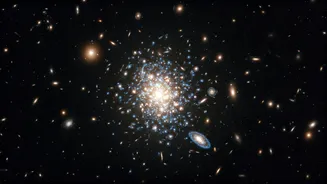
Imagine a city, not of buildings, but of entire galaxies. That gives you a sense of a galaxy cluster. These are the largest known gravitationally bound objects in the universe, collections of hundreds or even thousands of galaxies, all swimming in a vast
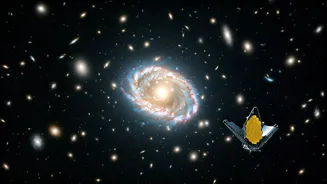
sea of superheated gas and held together by the immense pull of dark matter. They are the universe's ultimate metropolises, cosmic crossroads where galaxies live, interact, and evolve. Because they are so massive, they act as powerful gravitational lenses, bending and magnifying the light from even more distant objects behind them. This phenomenon allows telescopes like the James Webb Space Telescope (JWST) to peer deeper into the early universe than would otherwise be possible.
The Cosmic Rulebook
To understand the universe, cosmologists rely on a 'standard model' called Lambda-CDM (ΛCDM). Think of it as the master blueprint for the cosmos. The 'Lambda' (Λ) represents dark energy, a mysterious force causing the universe's expansion to accelerate, while 'CDM' stands for Cold Dark Matter, the invisible substance that provides the gravitational scaffolding for large structures to form. This model has been incredibly successful, accurately predicting many observed features of the universe, from the afterglow of the Big Bang (the Cosmic Microwave Background) to the web-like distribution of galaxies. According to ΛCDM, structures like galaxy clusters should form gradually over billions of years as gravity pulls matter together.
A Wrinkle in the Cosmos
Here's where the trouble starts. Recent observations are finding galaxy clusters that appear to be too massive, too early. In early 2026, astronomers studying a distant protocluster named SPT2349-56 found that the gas within it was at least five times hotter than the standard ΛCDM model predicts for a structure so young. We see this cluster as it was just 1.4 billion years after the Big Bang, and its surprising heat suggests a much more violent and rapid formation process, possibly fueled by supermassive black holes. Similarly, recent JWST observations of another cluster, XLSSC 122, revealed a surprisingly mature and dense structure existing just 3.4 billion years after the Big Bang, a time when such objects were thought to be just beginning to assemble. The fact that this cluster is already acting as a strong gravitational lens suggests it is far more developed than expected.
Crisis or Correction?
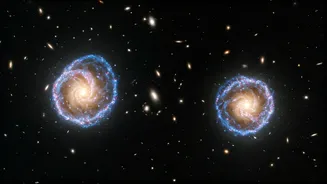
Do these findings mean the ΛCDM model is broken? Not necessarily. Science is a process of refining theories based on new evidence. These discrepancies, often called 'cosmological tensions,' are a hot topic of debate. Some studies of galaxy clusters still show strong agreement with ΛCDM predictions. However, the growing number of anomalies suggests something is missing from our understanding. The problem could lie in the complex physics of galaxy formation, which are difficult to simulate, or it could be a sign that our theory of gravity or the nature of dark matter needs a major revision. Discoveries of other enormous structures, like the 'Big Ring,' which is so large that its existence is hard to explain, further complicate the picture. These findings force scientists to ask if they are seeing evidence of new physics or just the limits of current data and simulations.
The Next Generation of Eyes
Resolving these tensions is a primary goal for the next generation of telescopes. The James Webb Space Telescope continues to deliver unprecedented views of the early universe. It is joined by the European Space Agency's Euclid telescope, a mission specifically designed to map the geometry of the dark universe by observing billions of galaxies. Euclid's vast surveys will create the most extensive 3D map of the cosmos, precisely measuring the distribution and shapes of galaxies to test how dark matter and dark energy have influenced their evolution. By gathering more data on clusters from different cosmic eras, scientists hope to determine whether these early, massive structures are rare exceptions or a common feature that requires a new cosmic rulebook.