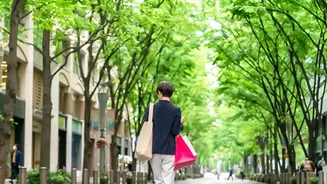




In a world often dominated by traffic, the simple joy of a leisurely stroll is a true luxury. Thankfully, cities across the globe are reclaiming their streets, creating vibrant, car-free zones where culture and community thrive on a human scale.
Strøget, Copenhagen, Denmark
As one
of Europe's longest pedestrian-only shopping areas, Strøget is more than just a street; it's the heart of Copenhagen's social life. Stretching over a kilometre, it connects the City Hall Square to Kongens Nytorv ('The King's New Square'). Since going car-free in 1962, it has become a model for urban planning worldwide. The street is a bustling mix of high-end luxury brands like Prada and Gucci near Kongens Nytorv, and more accessible stores like H&M and Zara closer to the City Hall. But the experience goes beyond shopping. The wide, open space is filled with street performers, musicians, and lively squares like Amagertorv, inviting you to sit at a cafe and simply watch the world go by. In summer, up to 80,000 people walk this street daily, making it a vibrant hub of activity.
Rue du Petit Champlain, Quebec City, Canada
Nestled at the foot of Cap Diamant in Old Québec, Rue du Petit Champlain feels like stepping into a European fairy tale. Often cited as one of North America's most beautiful streets, this narrow cobblestone lane is lined with beautifully restored 17th-century stone buildings. It's a fully pedestrianised area where every storefront is a unique artisan boutique, a local craft shop, or a charming bistro—you won't find large chain stores here. The street’s charm changes with the seasons, from blooming flower boxes in summer to magical snow-covered roofs and twinkling lights in winter. Don't miss the large 'Fresque du Petit-Champlain' mural, which depicts the area's history, and the famous Breakneck Stairs, which offer a picture-perfect view of the entire street. Part of a UNESCO World Heritage site, it’s a place best enjoyed at a slow, wandering pace.
The Shambles, York, England
To walk down The Shambles in York is to travel back to the Middle Ages. Considered one of the best-preserved medieval streets in the world, it was mentioned in the Domesday Book of 1086. Its name comes from 'fleshammels', an old Anglo-Saxon term for the shelves on which butchers displayed their meat. The street's most striking feature is its overhanging timber-framed buildings, some dating back to the 14th century. These structures were designed to lean in and shelter the meat below from direct sunlight. In some parts, the buildings are so close you can practically touch both sides of the street with your arms outstretched. While the butchers are long gone, replaced by quirky shops and cafes, many buildings still have the old meat-hooks outside.
Hosier Lane, Melbourne, Australia
Not all beautiful streets are defined by ancient architecture. Hosier Lane in Melbourne is a dynamic, ever-changing outdoor art gallery. This bluestone laneway, running between Flinders Street and Flinders Lane, is internationally renowned for its vibrant and often political street art. Since the late 1990s, it has become a de facto canvas for local and international artists, featuring everything from elaborate murals and stencils to pasteups and installations. As a 'free‐to‐paint' zone, the art is constantly evolving, meaning what you see one day might be painted over the next. This raw, creative energy makes every visit unique. The lane's location opposite Federation Square makes it a central and unmissable part of Melbourne's cultural fabric, celebrating a modern, urban form of pedestrian‐friendly exploration.
Rua Augusta, Lisbon, Portugal
The grand ceremonial spine of Lisbon's Baixa district, Rua Augusta is a lively pedestrian street connecting two of the city's most important squares : Rossio and Praça do Comércio . Flanked by majestic buildings constructed after the great earthquake of $1755$, the street is paved with traditional black‐and‐white mosaic cobblestones . It culminates at the southern end with the magnificent Arco da Rua Augusta , a triumphal arch you can ascend for stunning $360$-degree views of the city and the Tagus river . The street buzzes with energy , filled with international shops , outdoor cafes , and street performers . Unlike much of hilly Lisbon , Rua Augusta is completely flat , making it a pleasant and accessible stroll for everyone . It is the perfect place to feel the pulse of the Portuguese capital .