

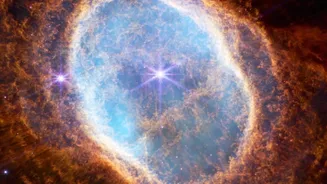
A Breakthrough Observation
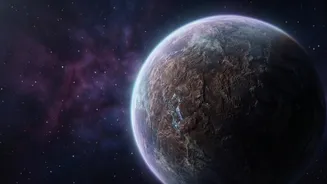
Scientists have announced that the James Webb Space Telescope has successfully detected signs of an atmosphere around a rocky exoplanet, with tantalizing hints of water vapour. The planet in question is 55 Cancri e, a super-Earth located 41 light-years
away. While water has been found on gaseous giants before, detecting it around a rocky planet is a significant first, offering the best evidence to date that terrestrial worlds outside our solar system can sustain atmospheres. This achievement pushes the boundaries of exoplanet characterization, allowing science to move from theory to tangible data about the conditions on these distant worlds. The discovery, made by analyzing the starlight filtering through the planet’s atmosphere, opens a new chapter in the search for potentially habitable environments.
What Exactly is a Super-Earth?
The term “super-Earth” might sound like a bigger, better version of our own planet, but it’s a specific classification for an exoplanet with a mass higher than Earth’s but substantially below that of our solar system's ice giants, Uranus and Neptune. 55 Cancri e, for instance, is about twice the diameter of Earth and has roughly eight times the mass. These planets are of immense interest to astronomers because they are incredibly common throughout the galaxy. However, they are a class of planet not found in our own solar system, making them a fascinating mystery. Scientists are keen to understand if they are more like large, rocky worlds or small, gassy planets like a mini-Neptune. Finding one with an atmosphere helps piece together that puzzle.
Not Earth 2.0, But Still Significant
It is crucial to manage expectations. The detection of water vapour on 55 Cancri e does not mean we've found a lush, water-world ripe for life. This particular super-Earth is a hellish landscape, orbiting its star so closely that a year lasts less than 18 hours. Its surface is believed to be a molten ocean of magma with temperatures high enough to melt rock. The atmosphere detected is likely rich in carbon dioxide or carbon monoxide, possibly replenished by gases bubbling out of this magma ocean. So, while 55 Cancri e is far from habitable, the fact that a rocky planet this hot and close to its star can even maintain a significant atmosphere is a groundbreaking discovery. It suggests that atmospheres on rocky planets may be more resilient than previously thought.
The Power of the Webb Telescope
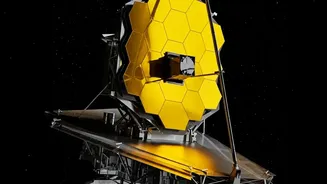
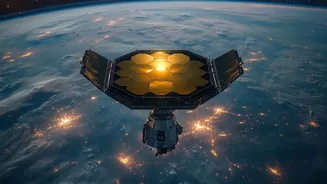
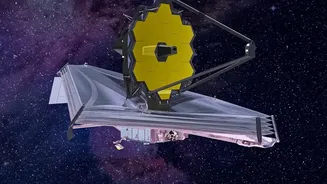
This discovery was made possible by the unprecedented power and sensitivity of the James Webb Space Telescope. Webb’s instruments, like the Near-Infrared Spectrograph (NIRSpec) and Mid-Infrared Instrument (MIRI), can perform a technique called transmission spectroscopy. As an exoplanet passes in front of its host star, a tiny fraction of the starlight is filtered through the planet's atmosphere. Within that light is a chemical fingerprint—the unique signatures of the molecules present. Webb can analyze these faint signals to identify gases like water vapour, carbon dioxide, and methane. Before JWST, detecting the thin atmosphere of a small, rocky planet was largely beyond our technical reach. This ability marks a new era, allowing astronomers to characterize worlds that could one day prove to be more Earth-like.
The Search for Habitable Worlds Continues
The findings on 55 Cancri e are a proof of concept. They demonstrate that JWST has the capability to find and analyze the atmospheres of rocky planets. The next step is to apply this technique to super-Earths that are not molten lava worlds, but instead orbit within their star's “habitable zone”—the region where temperatures could allow liquid water to exist on the surface. Discoveries like the one on K2-18b, another super-Earth in the habitable zone where the Hubble telescope previously found water vapour, will be revisited with Webb’s more powerful gaze for a clearer picture. Each detection provides a crucial data point, helping scientists understand how common water-rich worlds might be and narrowing the search for a planet that truly resembles our own.