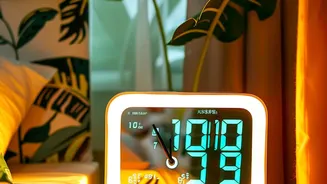







Have you ever noticed how the clock on your microwave and the one on your phone slowly drift apart? One is always right, while the other seems to live in its own time zone. This isn't just a quirk; it’s a window into how timekeeping works.
The Heartbeat Inside Every Clock
At the core
of most digital clocks, from wristwatches to kitchen appliances, is a tiny, tuning-fork-shaped piece of quartz crystal. When an electric current from a battery or wall outlet passes through it, the crystal vibrates at an incredibly precise frequency: exactly 32,768 times per second. An electronic circuit inside the clock counts these vibrations, and for every 32,768 'ticks' it counts, it adds one second to the display. This quartz oscillator is a marvel of engineering, providing a cheap and reliable way to measure the passing of time. It's the silent, steady heartbeat powering countless devices in our daily lives.
The Inevitable Problem of Drift
While quartz crystals are remarkably stable, they aren't perfect. Their vibration frequency can be subtly altered by environmental factors. Changes in temperature are the biggest culprit; as a room warms up or cools down, the crystal expands or contracts slightly, changing its vibration speed. Aging also plays a role, as the crystal's physical properties can change over years, causing it to slow down. These imperfections lead to 'clock drift'—a slow, cumulative error. A clock might lose or gain just a fraction of a second each day, but over a year, this can add up to several minutes, which is why your oven clock eventually needs resetting.
The Need for a Master Clock
For a simple alarm clock, a few minutes of drift per year is a minor annoyance. But in our interconnected world, precise, synchronised time is critical. Financial markets, computer networks, and air traffic control systems all depend on every device agreeing on the exact time, down to the millisecond. This is impossible if every clock is just relying on its own imperfect internal crystal. The solution is to have them all periodically check in with a hyper-accurate, reliable reference—a master clock—to correct any drift. This is where time synchronization protocols come into play.
The Internet’s Timekeeper: NTP
Your smartphone, laptop, and smart TV stay perfectly accurate because they use the Network Time Protocol (NTP). These devices connect over the internet to a global network of NTP servers. These servers are organized in a hierarchy, with the top-level 'Stratum 1' servers getting their time directly from the most accurate sources possible: atomic clocks. Your phone sends a request to a server, receives a timestamp, and intelligently adjusts its own clock, even accounting for the network delay in the signal. This happens silently and automatically, ensuring your devices are always synchronized to Coordinated Universal Time (UTC), the world's time standard.
Time from the Sky and Airwaves
What about devices that aren't on the internet? Many clocks and watches use other methods. So-called 'atomic clocks' you can buy for your wall are actually radio-controlled clocks. They contain a small antenna that receives a low-frequency radio signal broadcast from a national time standard, like the WWVB station in Colorado, which gets its time from an atomic clock. An even more robust reference is the Global Positioning System (GPS). Each GPS satellite has multiple atomic clocks on board. GPS receivers on the ground use signals from multiple satellites to calculate the precise time, accurate to within nanoseconds, independent of any internet connection.