



A New Frontier for India
Chandrayaan-4 is a robotic lunar sample-return mission, a major technological leap for India's space program. The primary goal is to soft-land on the Moon, collect up to 3 kg of lunar soil (regolith) and sub-surface material, and return it safely to Earth
for scientific study. This would make India only the fourth country in the world—after the United States, the former Soviet Union, and China—to accomplish such a feat. Approved by the Union Cabinet in September 2024, the mission represents a significant step towards India's long-term goals, which include a future human landing on the Moon by 2040.
An Intricate Five-Module Ballet
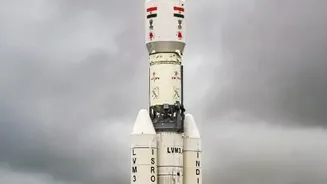
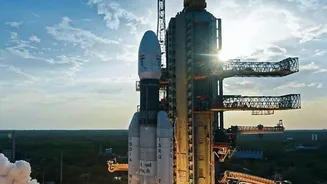
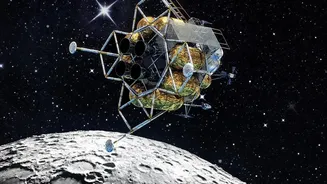
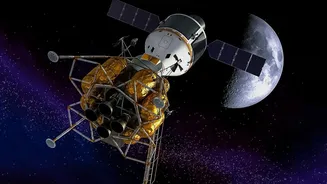
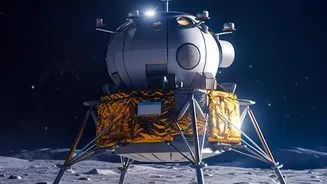
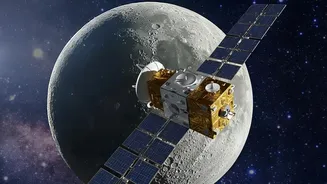
The mission's complexity is reflected in its architecture, which involves five distinct modules. Because the combined weight of over 9,000 kg is too heavy for a single rocket, ISRO plans a dual-launch strategy using two of its powerful LVM3 launch vehicles. The modules are a Propulsion Module to travel towards the moon, a Descender (lander), an Ascender to lift off from the Moon, a Transfer Module for the journey back, and a Re-entry Module to bring the samples through Earth's atmosphere. In a first for ISRO, these components will dock in Earth's orbit to form the integrated spacecraft before beginning the journey to the Moon.
Targeting the Moon's Icy Secrets
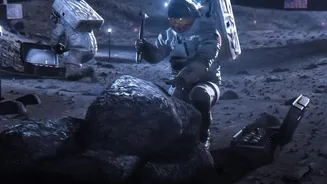
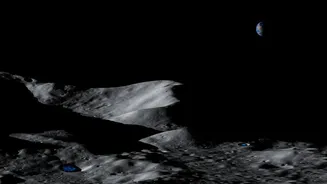
The mission will target the Moon's south polar region, a largely unexplored area of immense scientific interest. ISRO has identified a potential landing site in the Mons Mouton area, chosen for its relatively safe terrain and good solar illumination. This region is believed to be geologically diverse and, most importantly, is near Permanently Shadowed Regions (PSRs). These super-cold craters may contain water ice, a resource that could be vital for future long-term lunar exploration. Chandrayaan-4 will use a robotic arm and a drill to collect both surface regolith and sub-surface samples, which could potentially contain this ice.
The Clockwork of Collection and Return
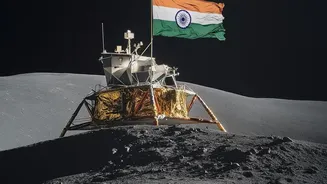
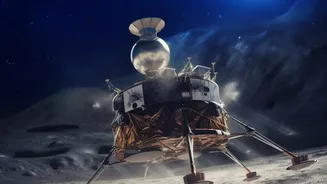
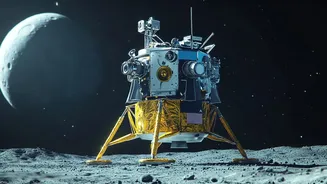
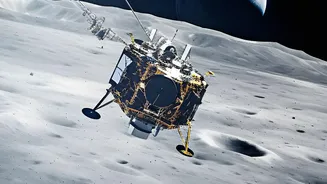
After a successful soft landing, the Descender Module will deploy a robotic arm to scoop up lunar soil and a drill to collect deeper material. These samples will be sealed in a container aboard the Ascender Module. At the end of the lunar day, the Ascender will launch from the Moon's surface, using the Descender as a launchpad. It will then rendezvous and dock with the Transfer Module orbiting the Moon. The samples will be robotically transferred to the Re-entry Module for the final leg of the journey. The Transfer Module will then fire its engines to head back to Earth, where it will release the capsule to perform a ballistic re-entry and landing.
Why Bring Back Moon Rocks?
While rovers and landers can perform amazing science on the lunar surface, their instruments are limited by size, weight, and power. Bringing samples to Earth allows scientists to use state-of-the-art laboratory equipment that is far too large or delicate to send to space. These samples can be studied for decades with ever-improving technology, answering questions that haven't even been thought of yet. Analyzing pristine material from a new, geologically diverse polar region can provide groundbreaking insights into the Moon's origin, the history of the solar system's bombardment, and the distribution of water and other resources crucial for future exploration.