








A New Era of Ambition
ISRO's legacy was built on a pragmatic approach: using space technology for societal benefit, from weather forecasting to telecommunications. This foundation made India a formidable space power. However, the next decade marks a strategic pivot. The focus
is shifting from mastering foundational skills to demonstrating advanced, complex capabilities that place India in the top tier of spacefaring nations. This involves not just launching satellites, but establishing a sustained human presence in orbit, exploring other planets with landers and rovers, and revolutionizing launch economics. It’s a transition from being a participant in the space race to becoming a leader shaping its future.
The Human Frontier: Gaganyaan and a Home in Space
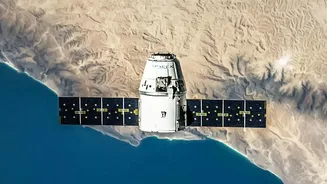
The most visible symbol of this new ambition is the Gaganyaan programme, India's first human spaceflight mission. Targeted for its first crewed flight around 2027, Gaganyaan aims to send a crew of three into a 400-km orbit for a three-day mission. But its significance extends far beyond this initial flight. Developing Gaganyaan means mastering critical technologies like life support systems, crew escape protocols, and safe re-entry—all essential for long-duration space habitation. This mission is the direct precursor to an even bolder project: the Bharatiya Antariksha Station (BAS), India's own modular space station. With its first module planned for launch in 2028 and full operation targeted for 2035, the BAS will serve as an orbital laboratory for scientific research and a crucial training ground for even deeper space exploration, including a planned crewed lunar landing by 2040.
Deep Space: Landing on the Moon and Mars
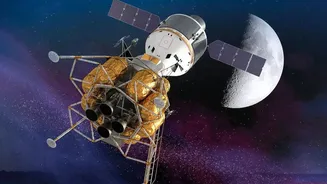
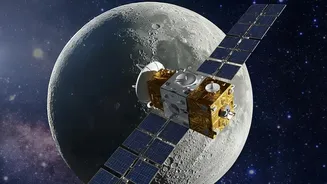
Building on the historic success of Chandrayaan-3's south pole landing, ISRO's lunar ambitions are growing. The pipeline includes Chandrayaan-4, a mission to retrieve lunar samples and return them to Earth, and Chandrayaan-5, a joint mission with Japan's space agency (JAXA) to explore the moon's polar regions with a more sophisticated lander and rover. The ambition isn't limited to the Moon. While the first Mangalyaan mission was a triumphant orbiter, Mangalyaan-2 is being designed to make India the fourth country to successfully land on Mars. Planned for around 2030, the mission may include not just a lander but also a rover and a helicopter, aiming to conduct on-ground studies of the Martian surface and atmosphere. These missions represent a shift from observing other celestial bodies to interacting with them directly.
The Game Changer: Reusable Launch Vehicles
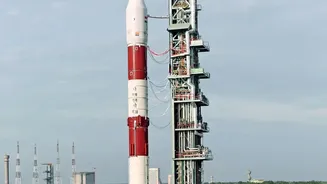
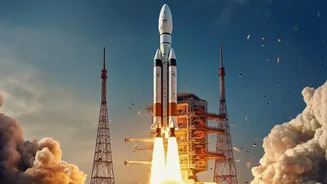
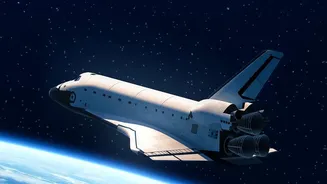
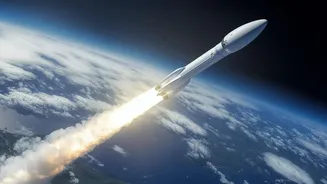
Perhaps the most transformative capability under development is in launch technology. ISRO is aggressively pursuing a Reusable Launch Vehicle (RLV) program, nicknamed Pushpak. Having completed a series of successful landing experiments, the program is moving towards orbital re-entry tests. A fully operational RLV, combined with the development of a new Next Generation Launch Vehicle (NGLV), aims to slash the cost of launching payloads into orbit by up to ten times. This drastic cost reduction is a strategic game-changer. It will make India a highly competitive player in the multi-billion dollar global commercial launch market, while also enabling ISRO to undertake more frequent and complex scientific missions that are currently cost-prohibitive. This technology is the economic engine that will power India's future in space.