


India's Sun Mission
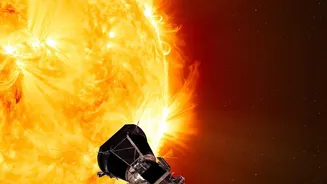
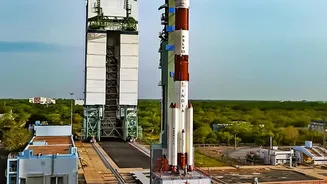
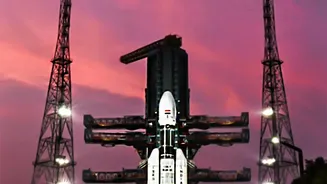
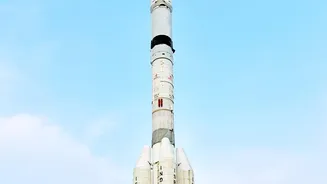
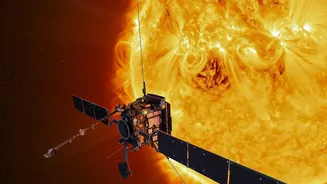
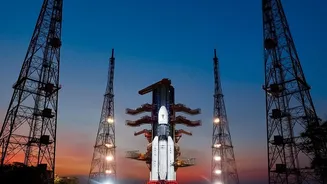
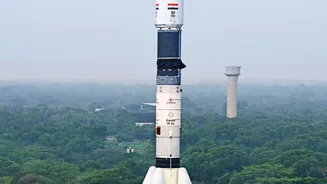
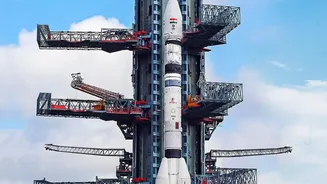
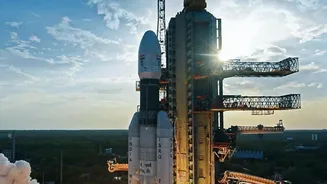
Launched in September 2023, the Aditya-L1 is the Indian Space Research Organisation's (ISRO) first dedicated mission to study the Sun. After a journey of about 1.5 million kilometres, it entered a halo orbit around the Sun-Earth Lagrange Point 1 (L1)
in January 2024. This unique vantage point allows the spacecraft's seven sophisticated payloads to continuously observe the Sun without any obstruction, providing crucial data on solar phenomena like coronal heating, solar flares, and the ever-present solar wind. The mission's primary goals include understanding the dynamics of the Sun's upper atmosphere and the physics that drive space weather.
What Are Solar Winds?
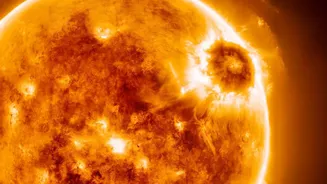
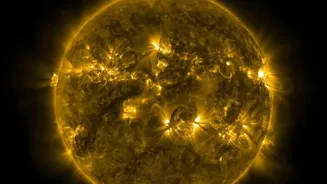
The Sun constantly emits a stream of charged particles—mostly protons and electrons—into space. This is the solar wind. It flows outwards, filling the entire solar system in a vast bubble called the heliosphere. While normally steady, the speed, density, and temperature of the solar wind can vary. These changes are often driven by dramatic events on the Sun's surface, such as Coronal Mass Ejections (CMEs), which are massive explosions of plasma and magnetic energy. Understanding these winds is vital because they can significantly impact Earth, affecting our magnetic field, satellites, communication networks, and power grids.
A Breakthrough Detection
Recent data from Aditya-L1 has revealed new details about the dynamic nature of solar winds. Payloads like the Plasma Analyser Package for Aditya (PAPA) and the Aditya Solar wind Particle Experiment (ASPEX) have been making in-situ measurements, essentially 'feeling' the solar wind as it passes. These instruments have successfully measured sudden shifts in solar wind dynamic pressure and identified the composition of particles within it, including protons and alpha particles. For example, during strong geomagnetic storms in May and October 2024, Aditya-L1's direct measurements were crucial in confirming that abrupt changes in solar wind pressure caused unusual magnetic disturbances recorded back on Earth.
The Instruments Behind the Data
Two key payloads are at the forefront of these solar wind discoveries: PAPA and ASPEX. PAPA is designed to analyse the composition and energy of solar wind electrons and ions. It contains two sensors: SWEEP (Solar Wind Electron Energy Probe) and SWICAR (Solar Wind Ion Composition Analyser), which together provide a comprehensive picture of the low-energy particles in the solar wind. ASPEX also has two components, one of which is the Solar Wind Ion Spectrometer (SWIS). SWIS has a 360-degree field of view that allows it to precisely measure the direction and properties of solar wind ions, helping scientists unravel longstanding questions about their behaviour. Together, these instruments function as ISRO's advanced weather station in space.
Why This Finding Matters
Detecting these dynamic shifts in solar wind is not just an academic exercise. It has profound real-world implications. By understanding how the pressure and composition of the solar wind change, especially ahead of a CME's arrival, scientists can significantly improve space weather forecasting. This acts as an early warning system. Better predictions can help protect our critical infrastructure, from the satellites that power GPS and communications to astronauts on space missions and even terrestrial power grids that are vulnerable to geomagnetic storms. These findings from Aditya-L1 showcase India's growing capability to contribute vital data to the global effort of monitoring the Sun and safeguarding our technology-dependent world.