





Why October Skies Are Special
October marks the beginning of India's prime stargazing season, which runs from October to March. The post-monsoon atmosphere is often clean and stable, providing excellent transparency and 'seeing' (atmospheric steadiness). The weather is generally pleasant
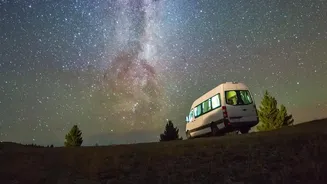
across the country, before the deep chill of winter sets in at higher altitudes. This month offers a fantastic window to see the dense star clouds of the Milky Way in Sagittarius setting in the southwest shortly after sunset, while the majestic Andromeda Galaxy rises high in the northeast. This combination of comfortable weather and clear, transitioning skies makes October an ideal time for both beginners and seasoned astronomers.
Choosing Your Stargazing Destination
The key to a great stargazing night is escaping city lights. Light pollution washes out all but the brightest stars, and finding a 'dark-sky' location is crucial. Fortunately, India has several world-class options. For the ultimate experience, head to Hanle in Ladakh, home to India's first designated Dark Sky Reserve. The high-altitude, dry conditions provide exceptionally clear skies. Spiti Valley in Himachal Pradesh offers similarly pristine, high-altitude skies and is a crown jewel of Indian stargazing, with the best conditions running from May to October. Other excellent choices include the Rann of Kutch in Gujarat, where the vast salt desert creates a surreal viewing platform, and Coorg in Karnataka for those in South India seeking dark skies in the Western Ghats. Even hill stations like Narkanda in Himachal Pradesh or locations near national parks can offer significantly darker skies than cities.
Celestial Highlights in October 2026
October 2026 is packed with exciting celestial events. The main attraction is the Orionid meteor shower, active from October 2 to November 7 and peaking on the night of October 21-22. These fast, bright meteors are debris from Halley's Comet, and you can expect to see 15-20 per hour in a dark location. For the best view in 2026, watch in the pre-dawn hours after the bright waxing gibbous moon sets. Earlier in the month, on October 4, Saturn will be at opposition, meaning it will be at its closest and brightest for the year, visible all night long. It's a perfect opportunity to spot its famous rings with a telescope. Throughout the month, you can also spot prominent constellations like Pegasus, known for its Great Square asterism, and the faint, beautiful Andromeda Galaxy.
Essential Gear for a Night Under the Stars
You don't need expensive equipment to start. The most important tool is your own eyes. However, a good pair of binoculars can dramatically enhance the view, revealing details on the Moon, the moons of Jupiter, and the faint glow of star clusters and nebulae. For identifying what you're seeing, stargazing apps like Stellarium or Sky Walk are invaluable. Dress in warm layers, as temperatures can drop significantly at night, even in warmer regions. A comfortable camping chair or a blanket to lie on will make hours of sky-watching much more enjoyable. Finally, use a red-light torch instead of a white one; red light helps preserve your night vision, which takes about 20-30 minutes to fully adapt to the dark.
Tips for Your First Stargazing Night
To make the most of your night, plan around the New Moon. The phase occurs on October 10, 2026, offering the darkest possible skies, which is the best time to see faint objects. When you arrive at your spot, give your eyes at least 20 minutes to adjust to the darkness. Avoid looking at bright screens on your phone. Patience is key; the longer you look, the more you will see. Start by learning to identify a few major constellations like Pegasus or, later in the evening, the rising Orion the Hunter, which becomes prominent from November. These will act as signposts to help you navigate the sky. And remember to bring snacks and water to stay comfortable.