






The Allure of a Hidden Ocean
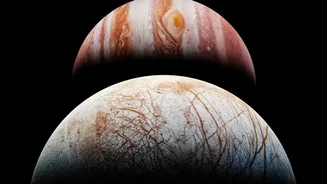
For decades, scientists have been captivated by Europa. It is considered one of the most promising places beyond Earth to find a currently habitable environment. Evidence strongly suggests a global ocean of saltwater exists beneath its icy crust, an ocean that
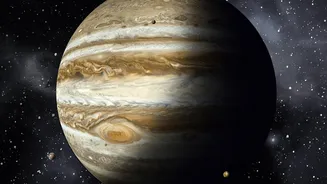
may contain more than twice the amount of water found in all of Earth's oceans combined. This massive body of water is kept liquid by the immense gravitational pull of Jupiter, which flexes and kneads the moon, generating enough internal heat to prevent it from freezing solid. The presence of water, energy, and essential chemical building blocks are the three key ingredients for life as we know it, and Europa appears to have them all. The primary goal of the Europa Clipper mission is to determine if this alien world could genuinely support life.
Meet the Ice-Penetrating Detective
To peer beneath an ice shell that could be anywhere from a few to tens of kilometers thick, you need a special kind of vision. Enter the Radar for Europa Assessment and Sounding: Ocean to Near-surface, or REASON. This instrument is one of nine powerful scientific tools aboard the Europa Clipper, but it is the only one that can look directly through the ice. REASON is a sophisticated ice-penetrating radar system. The technology was honed on Earth, where it has been used for decades to study the deep ice sheets of Antarctica and Greenland. Mounted on the spacecraft's sprawling solar arrays, REASON's antennas will transmit radio waves toward Europa's surface during dozens of close flybys, some as low as 25 kilometers (16 miles) above the ground.
How Radar Sees Through Ice
The principle behind REASON is similar to other radar systems, like a weather radar or a fish-finder. The instrument sends out radio waves at specific frequencies chosen for their unique properties. While visible light simply bounces off Europa's bright, icy surface, lower-frequency radio waves can penetrate deep into it. As these waves travel downward, they will reflect, or echo, back to the spacecraft whenever they hit a boundary between different materials. A change from solid ice to liquid water, or from pure ice to ice mixed with rocky impurities, will create a distinct echo. By measuring the time it takes for these signals to return and the change in their strength, scientists can build a detailed, three-dimensional map of what lies beneath.
Painting a 3D Subsurface Picture
REASON's main objective is to find the bottom of the ice shell—the point where the ice gives way to the vast ocean. Doing so will finally give scientists a definitive measurement of the shell's thickness. But its capabilities go far beyond that. The radar will also search for pockets of water trapped within the ice shell itself. These subglacial lakes, similar to those found under Antarctica's ice, could be crucial environments for potential life. They might also act as pathways, allowing chemical nutrients from Europa's radiation-blasted surface to mix with the ocean below, a key process for habitability. The data will reveal the internal structure of the ice, mapping out cracks, faults, and areas where warmer ice may be churning upwards.
More Than Just Thickness
By analyzing how the radio waves are altered as they pass through the ice and reflect off the water, REASON can also provide clues about the ocean's properties. For instance, the salinity—or saltiness—of the water affects how radar waves travel through it, and measurements from another instrument, a magnetometer, will help confirm the ocean's depth and salt content. The Europa Clipper will perform nearly 50 flybys, scanning almost the entire moon. Each pass will layer more data, creating a comprehensive picture of Europa's ice shell and the ocean it conceals. While the spacecraft is not designed to find life itself, the information gathered by REASON will be fundamental to understanding Europa's potential habitability. It will identify the most promising locations for a future lander to one day touch down and directly search for signs of life.