

A Star's Violent Finale
Most stars in the galaxy, including our own Sun, are destined to become white dwarfs. But this transition is anything but peaceful. Towards the end of its life, a star will swell into a 'red giant', expanding its fiery outer layers to an enormous size.
This expansion engulfs and vaporizes any planets orbiting too closely. After this destructive phase, the star sheds its outer atmosphere, leaving behind a tiny, incredibly dense, and hot core—a white dwarf. For a long time, it was assumed that these stellar remnants were simply graveyards, the final, quiet end of a solar system. Any planets that might have survived would have been pushed into distant, cold orbits, leaving the white dwarf itself lonely and barren.
From Debris to a Dusty Disc
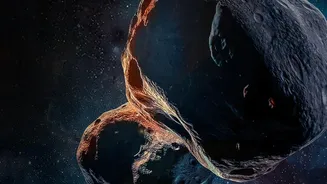
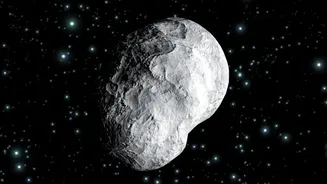
The story, however, is proving to be far more interesting. The gravitational pull of a white dwarf is immense. While the red giant phase destroys inner planets, it can also destabilize the orbits of surviving outer planets, asteroids, and comets. Over millions of years, these surviving bodies can be nudged onto paths that bring them too close to the white dwarf. Torn apart by its intense gravity, they are shredded into dust, rock, and gas. This material doesn't just disappear; it settles into a swirling, flat ring around the dead star. Astronomers have now found compelling evidence for these 'debris discs' around numerous white dwarfs. These discs are essentially the ghosts of old planets, providing a reservoir of raw material for something entirely new to emerge.
The Tell-Tale Scars of Accretion
Finding these discs is one thing, but seeing the process in action provides the smoking gun. Recently, astronomers observed a white dwarf named WD 0816-310 that offered exactly that. They discovered that its surface was 'scarred' with a concentration of metals. This is significant because the heavy elements in a white dwarf's atmosphere should sink out of sight quickly. The only way for them to be present is if the star is actively feeding on new material. In this case, the white dwarf's powerful magnetic field is funneling metals from its surrounding debris disc onto a specific part of its surface, creating the observed scar. This provides a direct link between the shattered remains of a planetary body and the white dwarf itself, confirming that these dead stars are actively consuming the building blocks of planets.
A Recipe for Planetary Rebirth
This leads to the most exciting possibility: if a white dwarf is surrounded by a dense disc of rock and dust, could new planets form within it? The theory is that this process would mirror how the first generation of planets formed. Over millions of years, tiny dust grains in the disc would start sticking together. Clumps would grow into pebbles, pebbles into boulders, and boulders into 'planetesimals'—the seeds of future planets. Eventually, one of these planetesimals could grow large enough to clear out its own orbit, becoming a fully-fledged second-generation planet. While a confirmed second-generation world has yet to be definitively identified, the necessary ingredients and processes are all there. Astronomers are now actively searching for these newborn worlds hidden within the dusty halos of dead stars.
A New Frontier for Alien Worlds
The hunt is fueled by tantalizing discoveries. Scientists have already confirmed the existence of giant planets that somehow survived their star's death, like the one found orbiting the white dwarf WD J0914+1914. The discovery of these survivors proved that planetary systems can, in some form, persist around white dwarfs. The prospect of second-generation planets adds another layer of intrigue. These new worlds would be fundamentally alien to us. They would be born in the twilight of their solar system, orbiting a faint, cooling ember that provides little light or warmth. Yet, the possibility that planetary formation is not a one-time event, but a cycle of destruction and recreation, fundamentally changes our understanding of the cosmos and opens up a vast, unexplored frontier in the search for planets outside our own solar system.