





A Glimpse of Alien Skies
Among the most tantalising targets for astronomers are 'super-Earths'—planets larger than our own but smaller than gas giants like Neptune. One of the most studied is 55 Cancri e, a world nearly twice the diameter of Earth located 41 light-years away.
For years, scientists have debated what kind of world it is. Its proximity to its star means its surface is likely a molten lava ocean. The big question was whether a planet this hot could even hold on to an atmosphere, or if it was just a bare, scorching rock.
Webb's Infrared Breakthrough
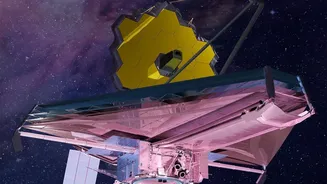
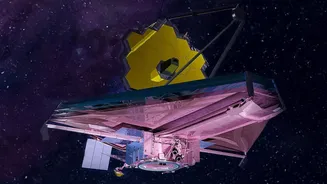
Previous observations with other telescopes, like the retired Spitzer Space Telescope, hinted at an atmosphere, but the evidence was not conclusive. Enter the James Webb Space Telescope (JWST). By precisely measuring the thermal glow of the planet in infrared light, JWST made a critical discovery. If 55 Cancri e were a bare rock, its dayside temperature should be around 2,200 degrees Celsius. Instead, Webb's instruments recorded a significantly cooler temperature of about 1,540 degrees Celsius. This temperature difference is the smoking gun: it indicates that heat is being distributed from the scorching dayside to the cooler nightside, a process that requires a substantial atmosphere.
An Atmosphere Born from Fire
This isn't just any atmosphere; it's what scientists call a 'secondary atmosphere'. Any original atmosphere the planet had would have been blasted away long ago by the intense heat and radiation from its parent star. Instead, the team believes this atmosphere is being constantly replenished from below. The immense heat keeps the planet's surface a churning ocean of magma, which releases dissolved gases like carbon monoxide and carbon dioxide. In essence, the planet is 'outgassing' its own atmosphere, a dynamic process that confirms a world far more active than a simple, inert rock.
Forecasting Lava-World Weather
The presence of this thick, gassy envelope confirms the existence of extreme weather systems. An atmosphere that can circulate heat implies powerful winds moving gases around the planet. This creates a bizarre weather cycle unlike anything in our solar system. On the permanent dayside, rock could be vaporized, rising into the atmosphere. These vapors would then be carried by winds to the cooler, permanent nightside, where they would condense and fall back to the surface as a form of rock or mineral rain. While not directly observed, the confirmation of a heat-distributing atmosphere makes such dynamic, planet-wide weather systems a near certainty. This finding represents the best evidence to date for an atmosphere around any rocky exoplanet.
Why This Discovery Matters
Studying a hellish lava world might seem far removed from the search for life, but it's a critical step. Proving that JWST can detect and characterise the atmosphere of a rocky planet is a monumental achievement in technology and science. It demonstrates that we have the tools to analyse the skies of planets that are much smaller and more Earth-like than the gas giants we've previously studied. The techniques used on 55 Cancri e are now being refined to search for atmospheres around cooler, rocky planets that orbit in their star's habitable zone—the region where liquid water could exist. This confirmation is a foundational piece of the puzzle in our quest to find another pale blue dot.