



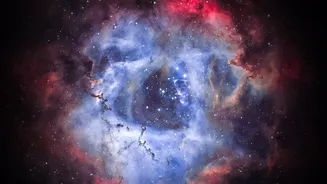
A Dying Star's Gaseous Ghost
Located about 650 light-years away in the constellation Aquarius, the Helix Nebula is one of the closest and most spectacular examples of a planetary nebula. Despite the name, it has nothing to do with planets. Instead, it's the beautiful, intricate remnant
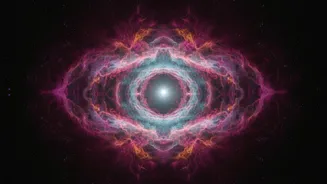
of a star similar to our own Sun that reached the end of its life. As the star died, it shed its outer layers of gas, which expanded into space. The central star, now a super-hot, dense white dwarf, floods these expanding gas shells with intense ultraviolet radiation, causing them to glow in brilliant colors. From our vantage point on Earth, the nebula's structure makes it look like a giant eye staring back at us across the cosmos, earning it the nickname the "Eye of God."
The Cosmic Tadpoles Revealed
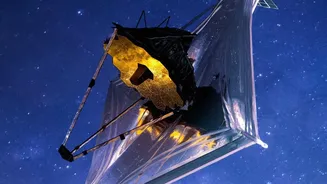
Dotting the inner ring of this celestial eye are thousands of mysterious, darker filaments. First observed in detail by the Hubble Space Telescope, astronomers dubbed them "cometary knots" because their bright, compact heads and long, trailing tails resemble comets. For years, their precise nature was a subject of study. We now know they are dense clumps of molecular gas and dust. Recent observations, including those from the James Webb Space Telescope, have provided an even clearer view of these structures in infrared light, revealing an estimated 40,000 of them within the nebula. They are a common, if not fully understood, feature in the final stages of a star's life.
Bigger Than Our Entire Solar System
Here's where our sense of perspective shatters. While they look like small specks in telescopic images, each of these knots is unimaginably large. The head of a single cometary knot is at least twice the size of our entire solar system, measured out to Pluto's orbit. Their delicate-looking tails are even more immense, stretching for 100 billion miles—about 1,000 times the distance from the Earth to the Sun. If you were to place one of these "tadpoles" in our cosmic neighborhood, its head alone would swallow the Sun and all its planets, and its tail would extend far beyond. The mass of each knot is comparable to that of Earth, packed into a gigantic, gaseous structure.
How They Get Their Shape
The iconic tadpole shape is a result of a violent cosmic sandblasting. The dense, cool knot of gas acts as a shield. As the central white dwarf star blasts out fierce stellar winds and radiation, this energy slams into the knots. The dense head of the knot withstands this onslaught, but the less dense material behind it is eroded and pushed away, streaming outward to form a long tail. The tails always point directly away from the central star, just as a comet's tail is pushed away by the Sun's solar wind. This process, called photoevaporation, slowly sculpts the gas and dust, creating the thousands of comet-like structures we see today. It’s a beautiful, large-scale demonstration of physics at work in the interstellar medium.