

The Old Story of Galaxy Growth
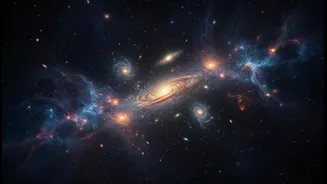
For decades, the story of how galaxies formed was one of slow, patient construction. The prevailing theory suggested that in the chaotic aftermath of the Big Bang, small, irregular blobs of stars and gas gradually came together. Over billions of years,
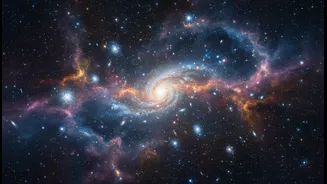
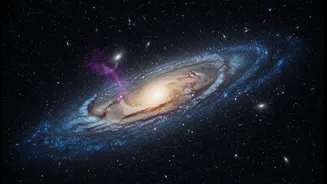
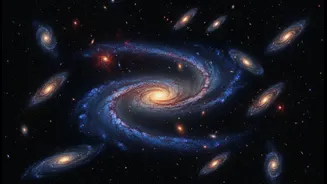
gravity would herd these smaller systems, causing them to merge and slowly build the grand, orderly structures we see in the universe today, like the elegant spiral arms of our own Milky Way. Complex features like dense central bars or rotating nuclear disks were thought to be hallmarks of maturity, features that could only appear in a galaxy after a long and stable evolution. This 'bottom-up' model was logical and supported by a great deal of observational evidence—until a new eye on the universe opened and started sending back some truly puzzling postcards from the past.
A Game-Changer Named Webb
The James Webb Space Telescope (JWST) has been a revolutionary tool for astronomers. By observing in infrared light, it can pierce through cosmic dust and capture light that has travelled for billions of years, offering an unprecedented glimpse into the universe's infancy. Recently, astronomers using Webb have been finding things that just shouldn't be there according to the old models. Several studies have identified surprisingly complex galaxies just a few billion years after the Big Bang. For instance, one team discovered a galaxy called COSMOS-74706, which appears to have a distinct stellar bar—a dense line of stars across its center—when the universe was only about two billion years old. Others have found galaxies that are already 'dead' or quiescent, meaning they've stopped forming stars, a characteristic usually associated with much more evolved systems.
What Are These Complex Structures?
When astronomers talk about 'complex structures', they're referring to features that show a high degree of organization. A stellar bar, like the one found in COSMOS-74706 and our own Milky Way, is a massive, elongated structure of stars and gas that cuts across a galaxy's center. These bars are not static; they are dynamic features that act like cosmic conveyor belts, funneling gas and material toward the galactic core. This process can fuel star formation in the center and potentially feed the supermassive black hole lurking there. Another such structure is a 'nuclear disk'—a dense, rotating disk of stars in the galaxy's innermost region. Because these features require a stable, well-ordered galaxy to form, finding them so early in cosmic history is like finding a teenager with the life experience and settled habits of a middle-aged adult.
Rewriting the Cosmic Timeline
These discoveries are forcing scientists to rethink the fundamental timeline of galaxy evolution. If galaxies could assemble these organised structures so quickly, what does that mean? It suggests that the processes driving galaxy formation might be more efficient or work differently than previously understood. Some simulations did predict that bars could form early, but finding observational proof is a huge step. These early, mature galaxies challenge simplified models of cosmic growth. It may be that the early universe was not as chaotic and clumpy as once believed, and that large, well-ordered disks could form more directly. The presence of these structures also has knock-on effects, influencing how quickly stars are born and how central black holes grow, rewriting entire chapters of galactic life stories.