




A Promising but Puzzling World
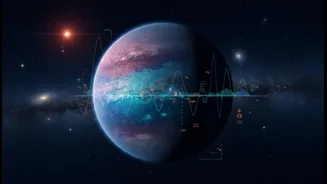
Exoplanet K2-18b has become a star player in the search for extraterrestrial life. Orbiting a red dwarf star in the constellation Leo, this 'sub-Neptune' is about 2.6 times the radius of Earth. Crucially, it sits in its star's habitable zone, where temperatures
could theoretically allow for liquid water. Observations by the James Webb Space Telescope (JWST) added to the intrigue, revealing an atmosphere containing methane and carbon dioxide. This discovery led to the classification of K2-18b as a potential 'Hycean' world—a hypothetical planet with a water ocean under a hydrogen-rich atmosphere. The most electrifying, and controversial, finding was the possible detection of dimethyl sulfide (DMS), a gas that on Earth is overwhelmingly produced by marine life like phytoplankton.
The Problem of False Positives
Detecting a potential biosignature like DMS is not the same as finding life. The scientific community has urged caution, as the DMS signal from K2-18b is weak and its interpretation is heavily debated. A major challenge in astrobiology is the problem of 'false positives'—chemicals or signs that seem to indicate life but could be produced by non-biological (abiotic) processes. Researchers have pointed out that abiotic processes, such as chemical reactions triggered by starlight, might be able to produce DMS in a hydrogen-rich atmosphere like K2-18b's. Furthermore, recent studies have suggested that DMS can exist in interstellar clouds and comets, proving it can be formed without any biological help. This means that simply finding a gas isn't enough; scientists need more context to be sure.
Enter Radio Waves
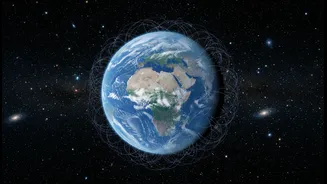
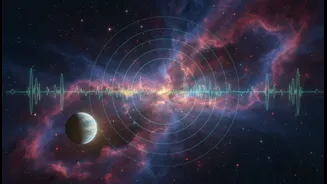
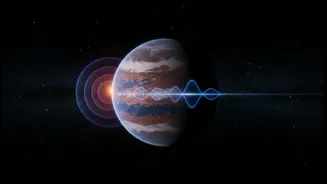
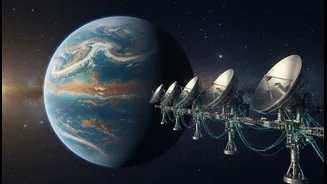
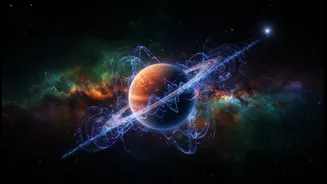
This is where a different kind of observation comes in: radio astronomy. Instead of looking for specific chemicals, scientists are proposing to use radio waves to understand the planet's fundamental environment. The key is to determine if K2-18b has a magnetic field. On Earth, our magnetosphere acts as a vital shield, protecting the atmosphere and surface life from harmful solar winds and cosmic radiation. A strong magnetic field is considered a critical ingredient for habitability. Detecting such a field on a distant exoplanet is incredibly difficult, but the interaction between a planet's magnetosphere and its star's stellar wind can generate radio emissions. By searching for these radio signals, astronomers can infer the presence and strength of a planetary magnetic field.
Listening for a Planetary Shield
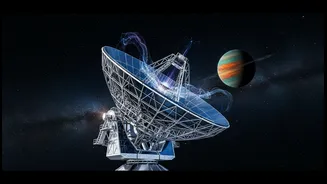
The logic is straightforward: if a planet has a robust magnetic field, it will produce detectable radio waves as charged particles from its star interact with it, similar to how Jupiter creates powerful radio signals. Observing these emissions would provide a powerful new way to probe an exoplanet's physical characteristics. The absence of such radio signals could be just as telling. A search using the Very Large Array radio telescope found no significant radio emissions from the K2-18 system. This suggests two possibilities. On one hand, it indicates that the host star is unusually quiet, which is good news for the planet's atmosphere, as it's less likely to be stripped away by intense stellar radiation. On the other hand, a lack of planetary radio signals could imply K2-18b has a weak or non-existent magnetic field.
Connecting the Dots to Find Life
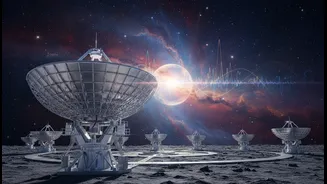
This radio data provides a crucial filter for interpreting the atmospheric findings from JWST. If follow-up observations confirm K2-18b lacks a protective magnetosphere, it would be a major strike against its potential to host surface life. Without this shield, any life would be exposed to sterilizing radiation, making a biological origin for the DMS signal highly unlikely. Conversely, if future, more sensitive radio telescopes—like the Square Kilometre Array or proposed lunar observatories—do detect a strong magnetic field, it would significantly boost the case for K2-18b's habitability. It wouldn't prove life exists, but it would confirm that a key condition for its survival is met. This technique allows scientists to move beyond just finding biosignatures and start assessing whether a planet is truly a habitable environment.