
A Planet for All Seasons
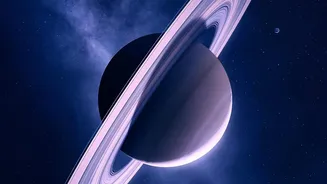
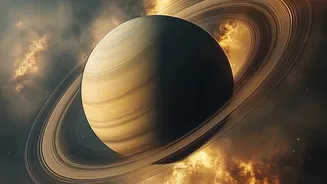
Like Earth, Saturn is tilted on its axis, which means it experiences seasons. But a year on Saturn lasts for more than 29 Earth years, making each of its seasons a lengthy affair of over seven years. This long, slow cycle of change is what makes consistent,
long-term observation so crucial. The Hubble Space Telescope, through its Outer Planet Atmospheres Legacy (OPAL) program, has been annually checking in on the gas giants, building a unique time-lapse of planetary weather. The latest observations capture the subtle but significant atmospheric shifts as the planet’s northern hemisphere transitions from summer towards autumn.
Decoding the Colors of Change
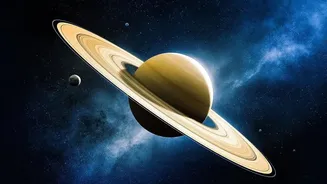
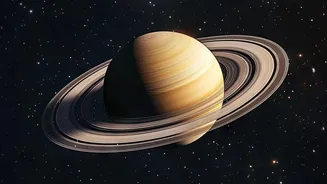
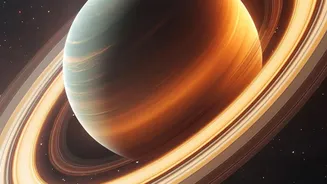
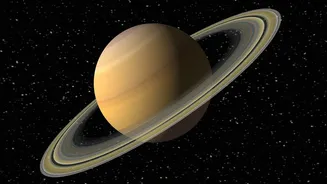
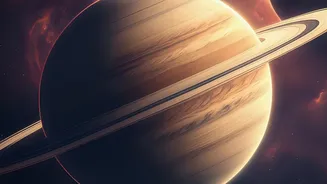
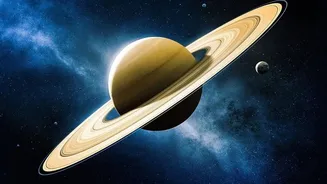
The new portraits of Saturn, taken as part of the OPAL project, show visible changes in the planet's colourful bands. Scientists have noted that from 2018 to 2020, Saturn's equator became between 5 and 10 percent brighter. These changes in colour and brightness are believed to be driven by shifts in the amount of sunlight the planet receives. As one hemisphere tilts toward the Sun, the increased ultraviolet radiation interacts with gases like methane in the atmosphere, affecting the amount and altitude of photochemical haze. This can alter the colours we see, providing a visual marker of seasonal progression on a planetary scale. The changes are subtle year-to-year, but over the course of a multi-year Saturnian season, they become dramatic.
A Tale of Two Telescopes
While Hubble observes in visible light, revealing the soft, banded colours of the upper atmosphere, it has recently been joined by the James Webb Space Telescope (JWST), which sees in infrared. This partnership provides an even more comprehensive view. A Hubble image from August 2024, combined with a JWST image from a few months later, allowed scientists to effectively 'slice' through Saturn's atmosphere at different altitudes. Webb can peer beneath the high-altitude haze to see deeper cloud structures and heat patterns. This dual approach helps researchers understand how the entire atmosphere works as a connected, three-dimensional system, from the deep winds to the sun-drenched upper layers.
Hubble's Enduring Watch
For over three decades, the Hubble Space Telescope has served as humanity’s persistent eye in the sky. Its ability to perform regular, long-term observations of the outer planets is unmatched. While missions like Cassini provided an incredibly detailed, close-up study of Saturn for 13 years, it was a finite mission. The OPAL program ensures that we continue to monitor these distant worlds, creating a baseline of data that helps scientists understand long-term cycles. These observations have not only tracked seasonal changes but have also serendipitously discovered new storms on Neptune and documented changes to Jupiter's Great Red Spot, proving the immense value of keeping a steady watch.