





From a Picture to a Movie
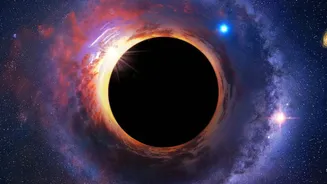
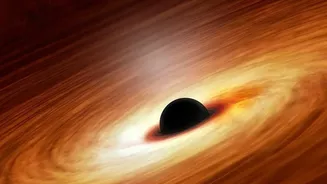
The star of this cosmic show is the supermassive black hole at the heart of the Messier 87 (M87) galaxy, located 55 million light-years from Earth. In 2019, the Event Horizon Telescope (EHT) collaboration made history by releasing the first-ever direct
image of this black hole, a glowing, donut-like ring of light surrounding a dark abyss. But science rarely stands still. Researchers have now analysed over a decade's worth of observational data, from 2009 to 2022, to see how this celestial behemoth behaves over time. This long-term view has allowed them to move beyond a single photograph and create a dynamic picture of the black hole, revealing that its features wobble and change.
An Earth-Sized Telescope
Capturing an image of something so distant and massive required a revolutionary approach called Very Long Baseline Interferometry (VLBI). The EHT isn't a single telescope but a global network of radio telescopes, scattered across continents from Hawaii to the South Pole and Spain to Chile. By precisely synchronizing these individual observatories using atomic clocks and having them all stare at the same object, astronomers effectively create a virtual telescope the size of our entire planet. This massive scale is what provides the incredible resolving power needed to see the shadow a black hole casts on the superheated gas swirling around it. Over the years, more telescopes have joined the array, continually improving its sensitivity.
A Decade of Data and Wobbling Jets
The most significant change observed over the long-term study is a 'wobble'. One study, analysing data from 2009 to 2017, found that the bright, crescent-shaped ring of plasma surrounding the black hole appears to wobble, which gives scientists clues about the turbulent flow of matter falling into it. An even more profound discovery came from analysing two decades of data, which revealed that the powerful jet of particles shooting out from the black hole is precessing, or wobbling, like a spinning top. This jet changes its orientation by about 10 degrees over an 11-year cycle. This painstaking analysis of years of radio signals, collected and then later combined by supercomputers, is what allowed scientists to spot this slow, rhythmic change.
Why This Wobble Is a Huge Deal
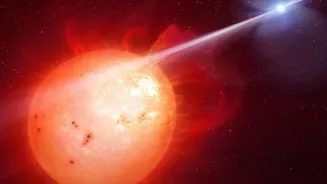
This observed wobble is more than just a curious movement; it's the first direct, observational proof that the M87 black hole is spinning. Albert Einstein's theory of General Relativity predicts an effect called 'frame-dragging', where a massive, rotating object literally drags spacetime around with it. Scientists believe this is what's happening at M87. The black hole's immense spin is pulling on the accretion disk of gas that feeds it, causing the entire structure—and the jet it launches—to wobble over time. This confirms a key prediction about how these powerful cosmic jets are powered, suggesting that the energy is extracted directly from the black hole's own rotation. It's a massive leap in our understanding of the physics governing these extreme environments.