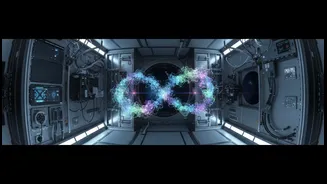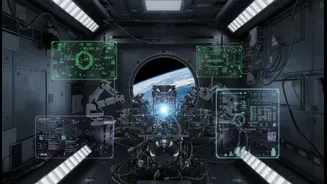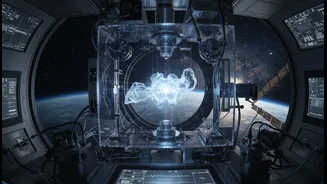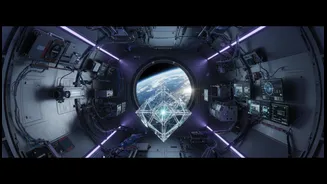





A Deep Freeze in Orbit
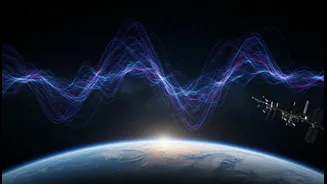
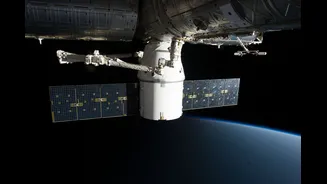
Since its installation in 2018, NASA's Cold Atom Lab (CAL) has been a quiet game-changer. Operated remotely from Earth, this sophisticated facility uses lasers and magnetic fields to cool atoms down to temperatures just a fraction of a degree above absolute
zero—the coldest temperature theoretically possible. At these extremes, matter behaves in ways that defy our everyday experience, giving scientists a unique window into the strange world of quantum mechanics. A major upgrade in 2026 has given this remarkable lab new capabilities, allowing researchers to probe the quantum realm with even greater control.
The Fifth State of Matter
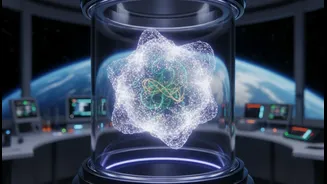
When atoms get this cold, they can enter a bizarre state of matter predicted by Albert Einstein and Satyendra Nath Bose nearly a century ago: the Bose-Einstein Condensate (BEC). It’s considered the fifth state of matter, distinct from solids, liquids, gases, and plasmas. In a BEC, individual atoms lose their identity and begin to behave as a single, collective entity, like a synchronized wave of quantum matter. This makes their quantum properties, which are usually hidden at microscopic scales, large enough to be observed and studied directly. The CAL was the first facility to produce a BEC in Earth's orbit, a major milestone for physics.
Why Microgravity Is the Secret Ingredient
Creating BECs on Earth is incredibly challenging because gravity constantly pulls on the atoms, causing the delicate condensate to collapse in fractions of a second. In the microgravity environment of the space station, this problem vanishes. The atom clouds are in a state of perpetual free-fall, allowing them to be observed for much longer periods—up to 10 seconds or more. This extended observation time is crucial, as it lets researchers watch how these quantum systems evolve and interact without the disruptive influence of gravity. It also allows the condensates to cool even further as they expand, reaching temperatures and creating matter waves larger than is possible on the ground.
New Tools for Quantum Exploration
The "fresh reason" to be excited about the CAL comes from its latest upgrade, the fourth since 2018. Sent to the ISS in April 2026, the new hardware includes a significantly improved magnetic trap. This doesn’t just hold the atom cloud in place; it allows scientists to actively shape it, squeezing the quantum gas into thin shells, lines, or other geometries. By manipulating the condensate's shape, researchers can study how its quantum properties change, leading to new insights into fundamental physics that are impossible to model with conventional computers. These experiments, creating strange objects like ultracold quantum bubbles, open entirely new avenues for research.
From Abstract Physics to Future Technology
While studying the fundamental nature of matter is the primary goal, the work being done on the CAL has profound practical implications. The ultra-precise control over atoms is the basis for a field known as atom interferometry. By manipulating the wave-like nature of atoms, scientists can build incredibly sensitive sensors. This technology could lead to next-generation atomic clocks, navigation systems for deep space exploration that don't rely on GPS, and instruments that can detect faint gravitational waves or even map mineral deposits underground on Earth. The CAL is not just a lab for abstract science; it's a testbed for the quantum technologies of tomorrow.