


Cosmic Construction Zones
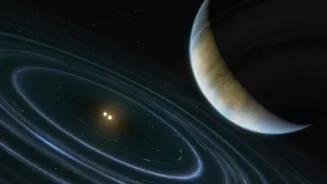
The birthplace of planets is a 'protoplanetary disk', a swirling platter of gas and dust that surrounds a young star for millions of years. Think of it as a cosmic construction site. Over time, tiny dust grains within this disk begin to stick together,
growing from pebbles into rocks, and eventually into the massive cores of planets. The amount of material and how long it lasts in the disk determines what kind of planets can form, from rocky worlds like Earth to gas giants like Jupiter. Understanding this process is key to figuring out not just how other solar systems take shape, but also the story of our own.
Powerful Eyes on the Sky
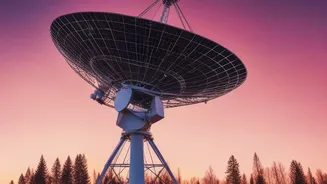
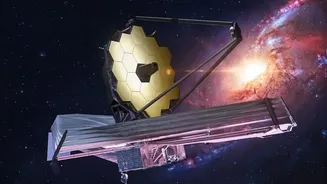
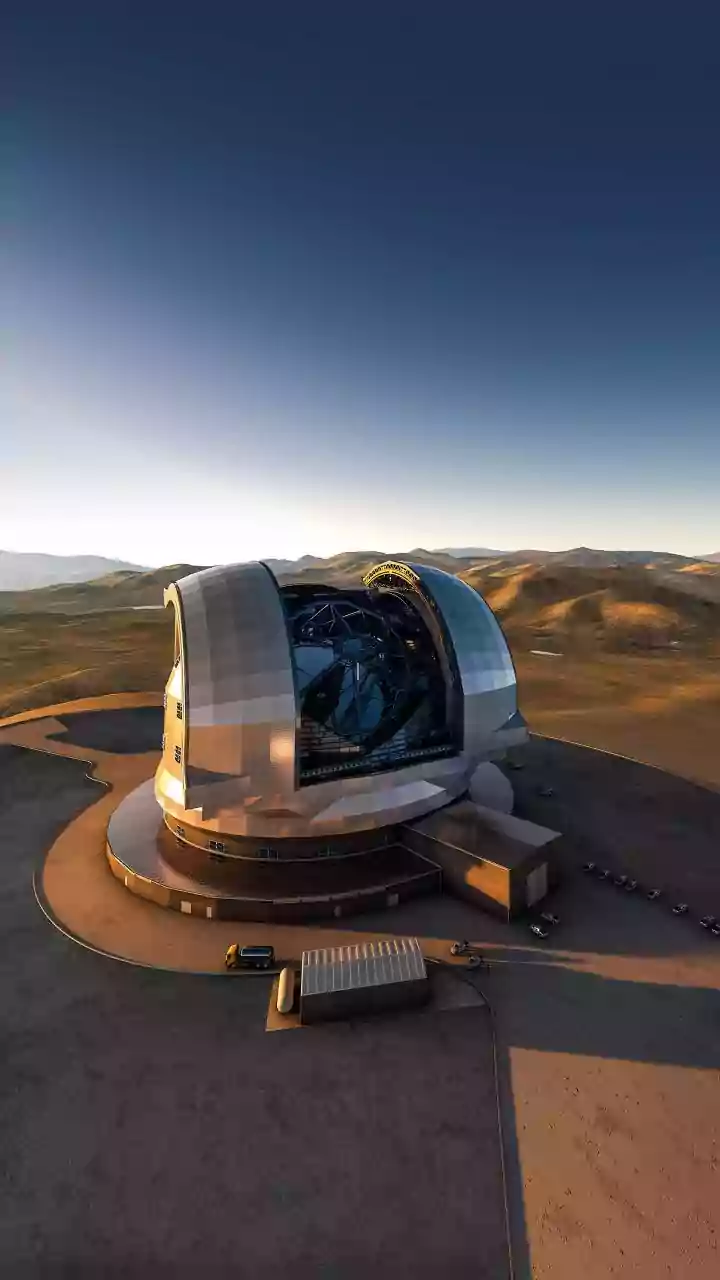
To study these distant nurseries, scientists need incredibly powerful tools. Since planet formation happens inside dense clouds of dust, visible light telescopes can't see what's going on. That's where observatories like the Atacama Large Millimeter/submillimeter Array (ALMA) in Chile and space-based telescopes like the James Webb Space Telescope (JWST) come in. ALMA uses a network of large antennas to detect faint radio waves emitted by cold dust and gas, allowing it to create astonishingly detailed images of disk structures. JWST, on the other hand, is sensitive to infrared light, letting it peer through the dust and study the chemical composition and temperature of these planet-forming regions.
Reading the Chemical Fingerprints
One of the most powerful techniques astronomers use is spectroscopy. This method involves breaking down the light from a star and its disk into a spectrum, like a rainbow. Different chemicals and molecules absorb and emit light at specific, predictable wavelengths, creating unique 'fingerprints'. By analyzing these spectra, scientists can figure out what a protoplanetary disk is made of, identifying crucial ingredients like water, carbon dioxide, methane, and various minerals. This tells them what raw materials are available for building new worlds and can even offer clues about the potential habitability of future planets.
Searching for Shadows and Wobbles
While directly seeing a planet forming is incredibly difficult, scientists can spot them through indirect methods. The 'transit method' looks for tiny, periodic dips in a star's brightness, which can happen when a planet passes in front of it. Another classic technique is the 'radial velocity' method, which detects the slight wobble of a star caused by the gravitational tug of an orbiting planet. While these methods are famous for finding fully-formed exoplanets, they can also be applied to young systems to find planets that are still growing within their birth disk.
Capturing the First Glimpse
The ultimate goal is to take a direct picture of a young planet, a feat that is exceptionally challenging. Planets are incredibly faint compared to the overwhelming glare of their parent star. To overcome this, astronomers use advanced instruments called coronagraphs, which act like a sophisticated sun visor to block the starlight and reveal the faint glow of a nearby planet. Using this technique, JWST has been able to directly image young, massive planets, providing a stunning confirmation of our theories about planet formation. Other images from ALMA have revealed gaps and rings in protoplanetary disks, which are considered tell-tale signs of unseen planets carving out their orbits.
From Giant Impacts to New Worlds
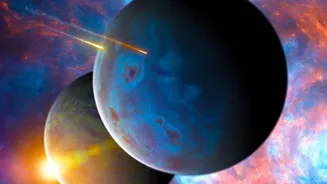
Recent findings from JWST have also highlighted the chaotic and violent nature of planet formation. Scientists have identified 'extreme debris disks' that contain unusually large amounts of warm dust. The composition of this dust, particularly its silica content, suggests it was created by massive collisions between planet-sized bodies — similar to the giant impact that is thought to have formed Earth's Moon. By studying the dusty fingerprints of these cosmic crashes, scientists are learning that planet formation isn't just a gentle process of accumulation, but also involves dramatic, world-altering events.