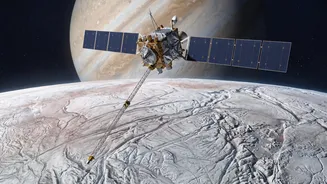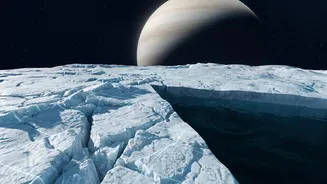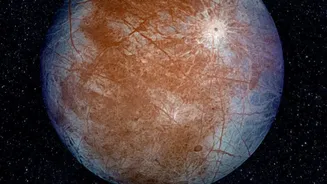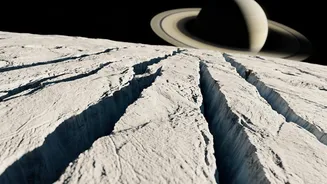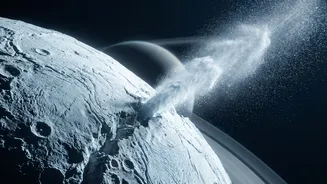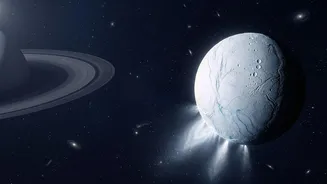




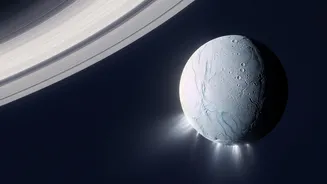

Beneath a thick crust of ice, Jupiter's moon Europa is thought to hide a vast, saltwater ocean. It’s one of the most promising places in our solar system to find life. Now, NASA’s Europa Clipper mission is on a journey to find out.
A Mission to an Ocean World
Launched in October
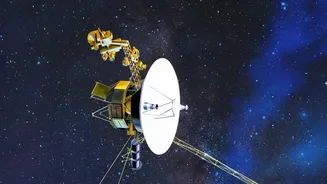
2024, the Europa Clipper spacecraft is undertaking a nearly 2.9-billion-kilometre journey to the Jupiter system. It is scheduled to arrive in April 2030, after which it will begin a series of nearly 50 close flybys of Europa. The primary goal is simple but profound: to determine if this enigmatic moon has conditions suitable for life. Scientists have strong evidence suggesting Europa conceals a global ocean with potentially twice as much water as all of Earth's oceans combined. However, this ocean is locked away beneath an ice shell of unknown thickness. To investigate, Clipper will not land but will act as a sophisticated reconnaissance probe, using a powerful suite of instruments to study the moon from orbit.
Meet the REASON Instrument
Of the nine science instruments aboard Europa Clipper, one is uniquely designed to peer directly through the ice: the Radar for Europa Assessment and Sounding: Ocean to Near-surface, or REASON. Developed by a team led by the University of Texas at Austin, REASON is an ice-penetrating radar. Its technology was honed by studying the massive ice sheets of Antarctica here on Earth. The instrument consists of large antennas that will emit radio waves at two different frequencies: a higher frequency (VHF) for detailed scans of the upper ice layers and a lower frequency (HF) designed to penetrate deep into the crust, possibly all the way to the ocean below. The goal is to create a 3D map of the ice shell's structure.
Painting a Picture with Radio Waves
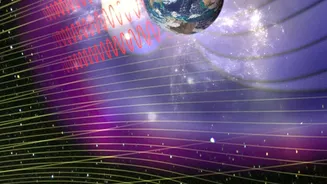
REASON works much like a geological ultrasound. It sends radio signals through Europa's surface; while visible light would simply bounce off the bright ice, these lower-frequency waves can pass right through it. When the radio waves encounter a change in material—such as a boundary between solid ice and liquid water, or a layer of trapped salty slush—they reflect back to the spacecraft. By measuring the time it takes for these echoes to return, scientists can determine the depth of these features. Furthermore, the strength of the returning signal provides clues about the material itself. This allows researchers on Earth to piece together a detailed cross-section of the ice shell, revealing its thickness and internal structure without ever touching it.
Searching for Pockets of Water
One of REASON's most crucial tasks is to search for pockets of liquid water that may be trapped within the ice shell. These subsurface lakes, similar to those found deep beneath Antarctic ice, could be vital for habitability. Life as we know it requires three main ingredients: liquid water, chemistry (the right elements), and energy. The surface of Europa is bombarded by radiation from Jupiter, creating energy-rich chemicals. For these chemicals to reach the ocean, there needs to be a pathway through the ice. REASON will search for evidence of these pathways by identifying fractures, faults, and areas where warmer ice might be churning upwards, potentially mixing surface materials with water below. Confirming their existence would be a huge step in assessing Europa's potential for hosting life.
Beyond the Ice: Confirming an Ocean
The ultimate prize for the REASON instrument would be to detect the boundary between the bottom of the ice shell and the top of the liquid water ocean. It is designed to probe as deep as 30 kilometres to find this interface. Confirming the ocean's existence and measuring the ice shell's thickness are among the mission's top objectives. While other instruments, like the magnetometer, will also help confirm the ocean by studying Europa's magnetic field, REASON offers the most direct look. The data gathered will not only reshape our understanding of this distant moon but will also be critical for planning future missions, perhaps even a lander that could one day touch down and sample the most promising areas identified by Clipper.