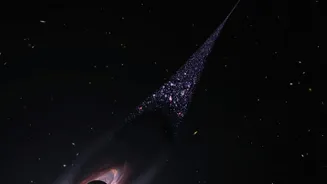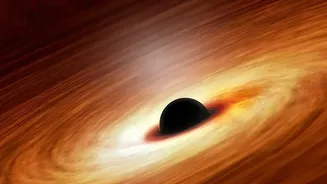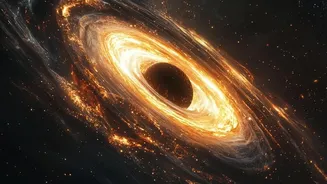



The universe is filled with objects of unimaginable scale, but few are as mind-bending as black holes. We know supermassive ones exist, but astronomers are now pondering an even larger class: stupendously large black holes, or SLABs.
Beyond Supermassive: A New Class of Giant
First, let's get the
terminology straight. Astronomers are familiar with several categories of black holes. There are stellar-mass black holes, a few times the mass of our sun, and supermassive black holes (SMBHs), which have masses of millions to billions of suns. One such SMBH, Sagittarius A*, sits at the heart of our own Milky Way galaxy. Beyond this, we have ultramassive black holes, which weigh in at over 10 billion solar masses. Stupendously large black holes, or SLABs, are a theoretical next step up, a class of cosmic monster with a proposed mass starting at 100 billion times that of the sun and potentially reaching a quintillion solar masses. To put that into perspective, a single SLAB could be more massive than some entire galaxies.
Why Do Scientists Think They Exist?
SLABs are not just a fun thought experiment; they emerge from theories about the early universe. One leading idea involves primordial black holes. Unlike black holes formed from collapsing stars, primordial black holes are theorised to have formed from extremely dense pockets of matter in the moments after the Big Bang. Because they were not created from stars, they aren't subject to the same size constraints. This could have allowed some to form with truly stupendous masses. Another line of thinking is that they could help solve the enduring mystery of dark matter. While recent studies suggest SLABs likely do not make up a major component of dark matter, the possibility has helped drive theoretical work and constrain their potential abundance.
The Hunt for Invisible Giants
So how do you find something that is, by its very nature, invisible and may not even exist? Scientists are using indirect methods to hunt for evidence of SLABs. One powerful technique is gravitational lensing. A massive object like a SLAB would warp the fabric of spacetime so much that it would bend the light from objects behind it, potentially creating multiple or distorted images of distant stars and galaxies. Another method involves looking for their shadows against the Cosmic Microwave Background (CMB), the faint afterglow of the Big Bang. A SLAB would cast a massive 'negative' spot on the CMB that could be detectable with microwave telescopes. Finally, their immense gravity would have disruptive effects on the structure of nearby galaxies, providing another potential signature.
The Challenges and Upper Limits
Despite these search methods, no SLAB has ever been detected, and they remain purely hypothetical. There are also physical limits to how large a black hole can realistically get through normal means. As a black hole grows by accreting matter, its accretion disk—the swirling disk of gas and dust feeding it—heats up. Eventually, the outward pressure from this radiation can become so intense it pushes away any more incoming fuel, effectively choking off its growth. Theoretical calculations place this limit for luminous accretion at around 50 billion solar masses, although this could extend up to about 270 billion solar masses for a rapidly spinning black hole. The largest black holes discovered so far, like the one powering the quasar TON 618, fall into the ultramassive category but are below the stupendous threshold. For SLABs to exist, they would likely need to have formed primordially or grown through other means, like a long series of mergers.