

Our Solar System's Icy Frontier
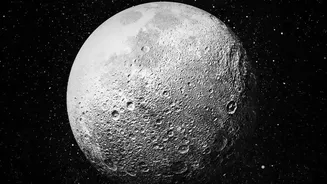
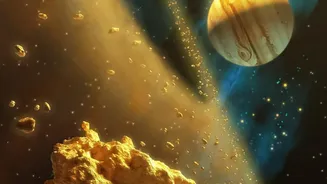
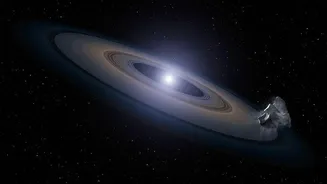
Beyond the orbit of Neptune lies the Kuiper Belt, a massive, donut-shaped region of space filled with millions of icy bodies. Think of it as a cosmic deep freeze, containing remnants from the formation of our solar system some 4.5 billion years ago. While
we know it’s home to dwarf planets like Pluto, and is composed of frozen volatiles like methane, ammonia, and water, sending missions to this distant region is extraordinarily difficult. This is why scientists often have to become cosmic detectives, studying clues that come to us instead.
Dust Bunnies from Billions of Kilometres Away
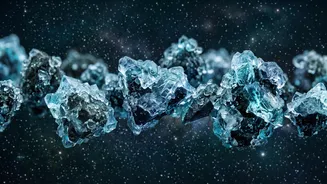
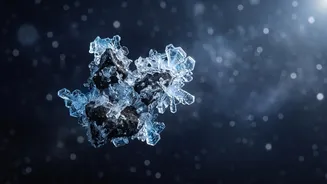
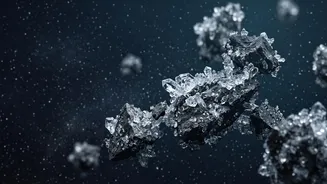
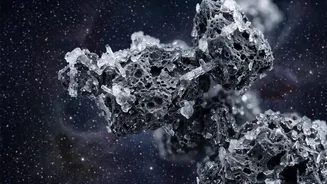
One of the best sources of clues is interplanetary dust. In a study published in 'Science Advances' on November 11, 2026, a team led by NASA planetary scientist Lindsay Keller examined 12 microscopic dust particles collected from Earth’s stratosphere by high-altitude aircraft. By analysing these grains, they could confirm their origin. The particles showed dense scarring from solar energetic particles, about 100 times more than dust from the closer asteroid belt, proving they came from the far-off Kuiper Belt. These tiny travellers were, in effect, samples delivered directly to our doorstep.
A Surprising Chemical Fingerprint
Upon closer inspection, the researchers made a remarkable discovery. The dust grains were largely made of clay minerals like saponite. These minerals only form when dry rock reacts with liquid water at low temperatures. This means that at some point in the distant past, the parent objects from which this dust originated must have contained liquid water, likely melted by heat from radioactive decay or ancient collisions. Though that liquid water is long gone, its chemical signature was locked away within the minerals.
The 'Heavy Water' Hypothesis
The most significant finding came from the water's isotopic composition. Isotopes are versions of an element with different numbers of neutrons. The oxygen within the minerals was unusually rich in 'heavy' oxygen isotopes (oxygen-17 and oxygen-18). By modelling the chemical reactions, the team determined the water that formed these minerals must have been similarly enriched. This 'heavy water' signature is distinctly different from the water found in our oceans or in meteorites from the inner solar system. It points to a primordial reservoir of water that was largely isolated, never mixing with the materials closer to the Sun.
Why This Isolated Reservoir Matters
This discovery provides powerful evidence for a long-standing theory that the outer solar system contains a separate, pristine water source. Scientists believe that early in the solar system's history, Saturn's formation may have created a pressure barrier, effectively acting as a wall that prevented material from the outer regions from mixing with the inner regions. This means the Kuiper Belt could be a time capsule, preserving the original chemical makeup of the solar system's outer edge. Understanding this ancient water helps us piece together the complete puzzle of how our solar system formed and evolved.
Connecting to the Bigger Picture
The find also complements other recent discoveries. NASA's New Horizons spacecraft, currently travelling through the Kuiper Belt, has detected more dust than models predicted, suggesting the belt may be larger or contain more objects than previously thought. Each speck of dust, whether measured in space or collected on Earth, adds a new piece to our understanding. It helps us reconstruct the history of water in our solar system, from the oceans of Earth to the suspected subsurface oceans on moons like Europa and Enceladus, and now, to this vast, ancient reservoir at the very edge of our planetary neighbourhood.