






The Goldilocks Guideline
For decades, the habitable zone has been our primary guide for where to look for life beyond Earth. It describes the orbital range where a planet could theoretically maintain liquid water on its surface, a key ingredient for life as we know it. If a planet is
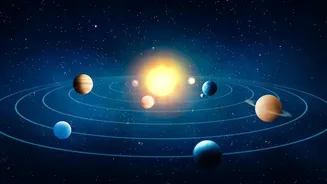
too close to its star, its water boils away. Too far, and it freezes. This simple definition gives astronomers a convenient way to filter through the thousands of exoplanets we’ve discovered, flagging worlds that are 'just right'. Our own solar system offers a perfect example: Earth sits comfortably in the Sun's habitable zone, while Venus is too hot and Mars is too cold, despite being its neighbours. This concept has successfully focused our search, leading to exciting discoveries like the TRAPPIST-1 system, which has multiple Earth-sized planets within its star's habitable zone.
A Star's Temperament Matters
A planet's location is only part of the story; the nature of its host star is equally critical. Many exoplanets, including those in the TRAPPIST-1 system, orbit red dwarf stars. These stars are smaller and cooler than our sun, meaning their habitable zones are much closer. While this makes planets easier to spot, it comes with significant downsides. Planets in such tight orbits are often tidally locked, with one side perpetually facing the star in unending daylight and the other in permanent darkness. Furthermore, red dwarfs are known for their violent temper tantrums, frequently unleashing powerful flares of high-energy radiation that could strip a nearby planet of its atmosphere and render its surface sterile. This stellar activity can make even a perfectly placed planet inhospitable.
The Atmospheric Deal-Breaker
An atmosphere is the true climate-control system of a planet. Its presence and composition can make or break habitability, regardless of orbital address. Without our atmosphere's greenhouse effect, Earth's average temperature would plummet far below freezing. On the other hand, Venus, though further from the Sun than Mercury, is the hottest planet in our solar system because its incredibly thick, carbon-dioxide-rich atmosphere creates a runaway greenhouse effect. A planet in the habitable zone without a substantial atmosphere to trap heat and shield it from radiation is just a cold, barren rock. Therefore, scientists are now focused not just on finding planets, but on studying their atmospheres for clues about their true surface conditions.
A Planet's Inner Strength
What happens deep inside a planet is just as important as what happens above it. A molten core, like Earth's, can generate a global magnetic field. This magnetic shield is crucial for life, as it deflects the constant stream of charged particles from its star, known as stellar wind, which would otherwise strip away the planet's atmosphere over time. Mars, for example, is thought to have lost most of its early, thick atmosphere after its internal dynamo shut down and its magnetic field vanished. Additionally, an active geology, such as plate tectonics, helps regulate a planet's climate over geological timescales by cycling chemicals like carbon between the atmosphere, oceans, and rocky interior. A geologically dead world, even one in the perfect location, may not be able to maintain a stable environment long enough for life to emerge and thrive.
Life Beyond the Zone
The habitable zone concept is also limited because it only considers surface water. But some of the most compelling places to search for life in our own solar system are far outside this region. Moons like Jupiter's Europa and Saturn's Enceladus are covered in ice, but they are believed to harbor vast liquid water oceans deep beneath their frozen shells. This water is kept liquid not by the Sun, but by heat generated from the constant gravitational push and pull of their massive host planets—a process called tidal heating. These subsurface oceans could contain all the necessary ingredients for life, including water, chemical nutrients from the rocky seafloor, and energy sources, completely independent of sunlight. Recent research suggests that signs of life from these oceans could even survive near the surface, making them prime targets for future missions.