



A Galactic Center Stage
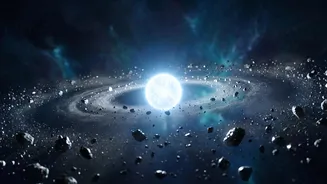
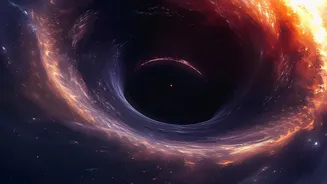
At the heart of our Milky Way galaxy, some 26,000 light-years from Earth, lies a supermassive black hole known as Sagittarius A, or Sgr A for short. With a mass more than four million times that of our Sun, it's a gravitational monster, but a surprisingly
quiet one. While black holes in other galaxies often put on spectacular light shows as they devour matter, Sgr A has been comparatively subdued. This has made it a frustrating, yet fascinating, subject for astronomers. Because we are so close, we have a 'front-row seat' to study a supermassive black hole, yet its tranquil nature and the dense clouds of gas and dust that shroud the galactic center make it incredibly difficult to observe directly.
The Decade-Long X-ray Vigil
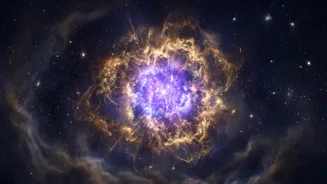
To pierce through the cosmic dust, astronomers rely on telescopes that can detect high-energy light, like X-rays. For the last ten years, NASA's NuSTAR (Nuclear Spectroscopic Telescope Array) has been staring into the galactic center, patiently collecting data. This long-term monitoring is crucial because Sgr A doesn't perform on command. Its activity comes in the form of unpredictable flares—dramatic, short-lived bursts of high-energy light that occur when clumps of gas or other material get too close and are torn apart by the black hole's immense gravity. Think of it as a cosmic firework display that provides a brief, intense flash of insight into an otherwise dark and hidden environment.
Uncovering Hidden Fireworks
Sifting through a decade's worth of this NuSTAR data, researchers at Michigan State University made a significant discovery. They identified nine previously unnoticed X-ray flares that erupted from Sgr A between 2015 and 2024. Finding these hidden gems was like discovering new entries in a ship's logbook that was thought to be complete. Each flare is a data point, a unique snapshot of the physics at play in one of the most extreme environments in the universe. By studying the intensity, duration, and energy of these flares, scientists can piece together a more detailed picture of the material swirling just outside the event horizon—the point of no return.
Echoes From the Past
The discovery isn't just about the flares themselves, but also their 'echoes'. The X-rays from these outbursts travel outwards, illuminating the vast clouds of gas and dust surrounding the black hole. These clouds, which cannot produce their own X-rays, light up when hit by a flare, reflecting the light like a mirror. By studying how this reflected light brightens and fades over years—one nearby gas cloud called 'the Bridge' peaked in brightness in 2020 after a 12-year increase—astronomers can map the invisible structures around Sgr A and learn about its activity from hundreds of years ago. It's a clever form of cosmic archaeology, using light echoes to reconstruct past events.
What It Means for Understanding Our Universe
These new findings provide vital clues to several long-standing cosmic puzzles. For one, they help explain the behaviour of a 'quiet' black hole, which is believed to be the dominant state for most galaxies. Furthermore, a separate study using five years of data from the ALMA radio telescopes in Chile has finally detected signs of a weak 'wind' being blown from Sgr A, solving a 50-year mystery of why it seemed to only be consuming material without expelling any, unlike other black holes. Together, these patient, decade-long observations are painting a more complete portrait of our galaxy's central engine, revealing that even in its quiet state, it is a dynamic and complex system that continues to shape its cosmic neighbourhood.