




A Sudden Glare in the Cosmic Dark
Astronomers have witnessed a dramatic and unprecedented event: the sudden awakening of a supermassive black hole in a galaxy hundreds of millions of light-years away. For years, the galaxy, known as SDSS1335+0728, was unremarkable and quiet. Then, in late
2019, it began to brighten dramatically, a process that has continued and intensified. Its luminosity has surged across the spectrum, becoming multiple times brighter in ultraviolet and mid-infrared wavelengths, and even beginning to emit X-rays, a tell-tale sign of high-energy activity. This isn't just a flicker; it's the real-time observation of a sleeping giant at the heart of a galaxy waking up and beginning to feast.
What It Means for a Black Hole to 'Activate'
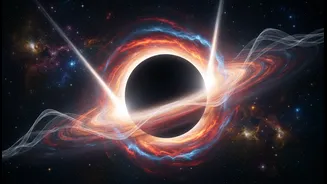
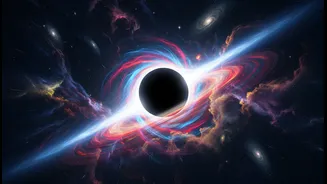
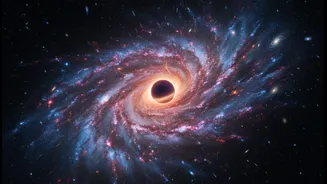
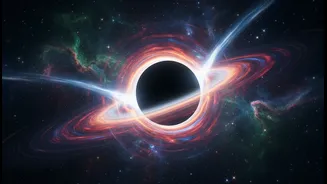
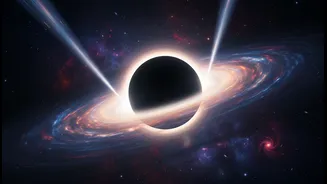
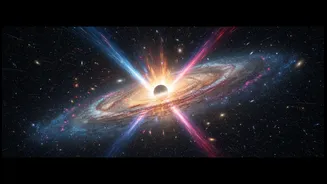
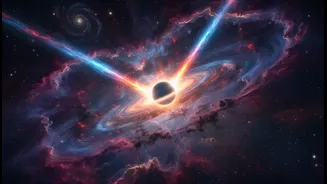
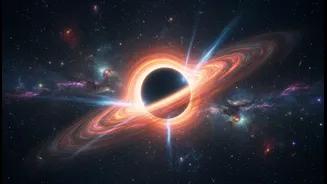
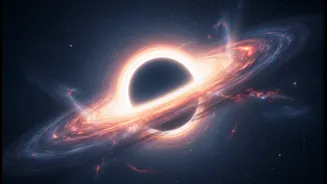
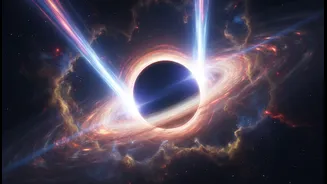
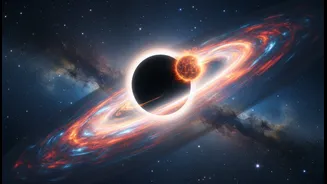
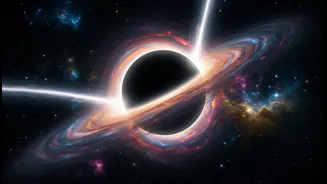
Supermassive black holes, with masses millions or billions of times that of our sun, reside at the centre of most large galaxies, including our own Milky Way. Most are dormant, or 'quiescent', meaning very little material is falling into them. An 'active' black hole, however, is one that is actively consuming large amounts of surrounding gas and dust. This material forms a massive, swirling structure called an accretion disk around the black hole. As matter spirals inward, intense friction and gravitational forces heat it to extreme temperatures, causing it to glow brilliantly across the universe. This glowing region is known as an Active Galactic Nucleus (AGN), and it can outshine all the stars in its host galaxy combined. The activation of SDSS1335+0728 is the first time scientists have seen this process turn on in real time.
The Light Speed Conundrum
Here is where the observation becomes truly puzzling and connects to the cosmic speed limit. The rapid and seemingly coordinated brightening across a vast region of space presents a timing problem. Information, and physical effects, cannot travel faster than the speed of light. If a black hole suddenly begins feeding, the 'news' of this event—in the form of light and heat—should propagate outwards from the centre of the accretion disk. For a disk that might be light-days or light-weeks across, one would expect to see the inner parts brighten first, followed by the outer parts. Yet in some of these sudden flare-ups, the entire region appears to light up almost simultaneously. This creates an illusion of faster-than-light propagation. While no object is actually breaking Einstein's famous law, the observation challenges scientific models of how accretion disks work.
An Illusion, But a Profound One
To be clear, physicists are not suggesting that matter or information is truly travelling faster than light. The scientific consensus is that faster-than-light travel would violate causality—the law of cause and effect—and is not possible. The phenomenon of 'apparent superluminal motion' has been observed before, particularly in jets of plasma fired from quasars. This is typically an optical illusion created when a jet is moving at near-light speed at a certain angle toward the observer. What makes the new observations so compelling is that the brightening is happening across a disk, not in a narrow jet. This forces scientists to reconsider their assumptions about the physics of these structures. Perhaps the disk was already in a 'pre-warmed' state, ready to transition all at once, or there is a complex magnetic or geometric effect that we don't yet understand.
Rewriting the Rules of Cosmic Behaviour
The true impact of this discovery is not in breaking the laws of physics, but in revealing that our understanding of cosmic phenomena is incomplete. The 'assumptions' being altered are not about the constancy of the speed of light itself, but about how black holes and their accretion disks behave. Such events force astrophysicists to develop new models that can account for such rapid, large-scale changes. This is how science progresses: a baffling observation challenges existing theories, prompting a deeper investigation that ultimately leads to a more refined understanding of the universe. The sudden activation of this distant black hole serves as a powerful reminder that the cosmos is filled with mysteries that push the boundaries of our knowledge, even when the fundamental rules, like the speed of light, remain intact.