







What is Space Medicine?
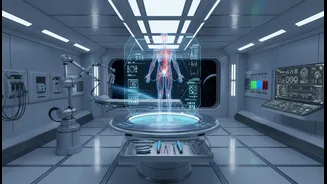
Space medicine is a specialized field focused on the health, safety, and performance of individuals in the extreme environment of space. It goes far beyond just treating illnesses. Specialists study the profound effects of microgravity, radiation, and confinement
on the human body. These include challenges like bone density loss, muscle atrophy, cardiovascular changes, and psychological stress. The goal is to develop countermeasures, technologies, and procedures to keep astronauts healthy during missions that could last months or even years. This field is a unique blend of clinical medicine, physiology, psychology, and engineering.
India's Leap into a New Frontier
The driving force behind the growing interest in space medicine in India is the nation's ambitious human spaceflight program, Gaganyaan. Successfully sending Indian astronauts, or 'Gaganauts', into orbit and bringing them back safely requires an unprecedented level of medical support. Recognizing this, the Indian Space Research Organisation (ISRO) is actively collaborating with top medical institutions. It has signed agreements with the Sree Chitra Tirunal Institute for Medical Sciences & Technology (SCTIMST) and the All India Institute of Medical Sciences (AIIMS) to advance research in areas like human physiology in microgravity, radiation biology, and biomedical support systems. These partnerships are crucial for building national capacity and developing the indigenous technologies needed for Gaganyaan and the planned Bharatiya Antariksh Station.
The Path for Medical Aspirants
For medical students with their sights set on the stars, the journey begins with an MBBS degree. The key specialization is an MD in Aerospace Medicine. In India, the premier and sole institution offering this postgraduate course is the Institute of Aerospace Medicine (IAM) in Bengaluru, which is run by the Indian Air Force. Admission is competitive, requiring qualification in the NEET-PG exam. The three-year program covers subjects like aviation physiology, human engineering, and spaceflight. While the course has a military focus, a limited number of seats are available for civilians, who may be required to sign a bond to serve in the Armed Forces Medical Services. Graduates are highly sought after by the armed forces, ISRO, and civil aviation regulators.
Engineering's Crucial Role
Space medicine is not exclusively for doctors; engineers play an equally vital role. The challenges of keeping humans alive in space are fundamentally engineering problems. Biomedical engineers are needed to design and develop life support systems, advanced medical monitoring devices, and even robotic tools for remote medical procedures. Mechanical engineers may work on habitation modules and life support hardware, while electronics and computer science engineers are critical for creating the instrumentation and software that monitor an astronaut's health in real-time. Even fields like materials science contribute by developing new materials that can shield against radiation or be used in medical implants. A strong foundation in an engineering discipline, coupled with an interest in biological sciences, can open doors to this interdisciplinary field.
Building the Right Skillset
Beyond academic qualifications, a career in space medicine demands a unique set of skills. Problem-solving under extreme pressure is paramount. The field is inherently interdisciplinary, so the ability for doctors and engineers to collaborate and 'speak each other's language' is essential for success. A strong aptitude for research is also crucial, as much of the work involves studying the unknown effects of space on the body and innovating new solutions. Aspiring professionals should cultivate adaptability and a passion for continuous learning. This is a field that is constantly evolving with every new mission and discovery, requiring its practitioners to be at the cutting edge of both medicine and technology.