



The Sun’s Great Mystery
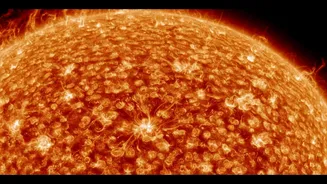
Imagine standing near a bonfire and feeling the air get much hotter the further you move away. This is precisely the puzzle the Sun presents. Its visible surface, the photosphere, has a temperature of about 5,500 degrees Celsius. Yet, its outer atmosphere,
the corona, sizzles at an astonishing one to two million degrees Celsius. This phenomenon, known as the coronal heating problem, has baffled astrophysicists since the 1930s. It defies the basic laws of thermodynamics, which suggest the corona should be cooler than the surface. To explain this discrepancy, scientists have long theorized that some mechanism must be transporting vast amounts of energy from the Sun's interior and depositing it into the corona. The prime suspect has always been the Sun's powerful and complex magnetic field.
Catching an Elusive Wave
The leading theory involves special kinds of magnetic plasma waves, known as Alfvén waves, which were first predicted in 1942. These waves are disturbances that travel along magnetic field lines, much like a vibration travelling down a guitar string. Scientists believe these waves carry energy upwards from the churning solar surface into the thin plasma of the corona. While larger, more obvious waves had been seen before, researchers have now managed to directly observe a more subtle, twisting type known as torsional Alfvén waves. Using powerful instruments like the Daniel K. Inouye Solar Telescope in Hawaii, scientists were able to detect the characteristic twisting motion of these waves, which were previously hidden by more dominant swaying motions in the plasma.
How Waves Turn Into Heat
Simply observing a wave is not enough; the key is understanding how its energy is converted into heat. One promising mechanism is through turbulence. Recent laboratory experiments mimicking conditions in the corona have shown that as Alfvén waves travel outwards, they can be reflected back by changes in plasma density. The collision between the outgoing and reflected waves creates turbulence, causing the wave's organised energy to break down and dissipate as heat into the surrounding plasma. This process effectively dumps the energy carried by the wave into the corona, raising its temperature significantly. Recent observations from the Solar Orbiter spacecraft have also found a hidden population of high-frequency waves, which are particularly effective at dissipating their energy as heat.
The Technology Behind the Discovery
Observing these phenomena requires incredibly advanced technology. The Solar Orbiter, a joint mission by the European Space Agency and NASA, is designed to take the closest-ever images of the Sun and study its polar regions. Its high-resolution imagers can detect rapid movements in the corona that were previously invisible. On the ground, the Daniel K. Inouye Solar Telescope provides an unprecedentedly clear view of the Sun's atmosphere, allowing scientists to perform spectroscopic analysis. This involves measuring how light from the plasma is shifted towards blue or red, which reveals how it's moving toward or away from Earth, exposing the subtle twisting motion of the torsional Alfvén waves.
Why Solving This Mystery Matters
Understanding the corona is not just an academic exercise. The same processes that heat the corona also drive the solar wind, a constant stream of charged particles flowing from the Sun that fills our solar system. Violent solar events, such as solar flares and coronal mass ejections, are also powered by the Sun's magnetic energy. These events can send powerful bursts of energy and particles toward Earth, posing a threat to our satellites, communication systems, and power grids. By finally piecing together how the Sun transports and releases energy, scientists can build better models to predict this 'space weather'. This will improve our ability to protect the vital infrastructure we all rely on.