

For billions of years, our solar system has run like a celestial clockwork. But new research suggests this stability may have an expiration date, with the Sun's chaotic final act potentially scrambling the orbits of its largest planets.
The Sun's Inevitable Decline
Our Sun, like all
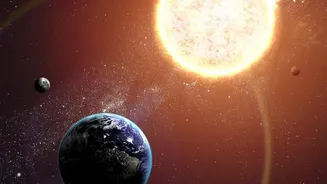
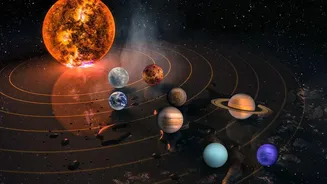
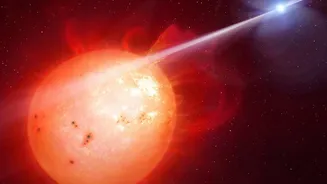
stars, has a finite lifespan. In about five billion years, it will exhaust the hydrogen fuel in its core and begin to die. This process will see it swell into a red giant, likely engulfing Mercury, Venus, and possibly Earth. As it expands, it will also shed about half of its total mass into space through powerful stellar winds. For decades, scientists believed this mass loss would be a smooth, continuous process. The gradual weakening of the Sun's gravity would cause the remaining planets—Jupiter, Saturn, Uranus, and Neptune—to drift gently outwards into wider, but still stable, orbits. Previous models predicted this orderly arrangement could last for another 100 billion years or even longer.
A Not-So-Smooth Exit
A new study published in The Astrophysical Journal Letters challenges this peaceful picture. Researchers now theorize that the Sun won't lose mass smoothly but in a series of thousands of discrete, violent bursts of plasma. Each of these ejections would act like a small rocket engine, giving the Sun a tiny, random push or 'kick'. While a single kick would be insignificant, the cumulative effect of thousands of these random nudges over millions of years could slowly alter the Sun's motion and disrupt the delicate gravitational balance of the entire outer solar system. This 'random walk' of the planets' orbits introduces a level of chaos not accounted for in older models.
Simulating a Chaotic Future
To test this new theory, researchers ran hundreds of computer simulations—672 in total—to model how the outer solar system would react to this 'stochastic' or random mass loss. They tested various scenarios, from the old smooth-loss model to new ones where the Sun expelled mass in uneven clumps. The results were dramatic. In scenarios with smooth mass loss, the solar system remained stable, as previously thought. But when uneven ejections were introduced, chaos ensued. In about 40% of the simulated systems, major disruptions occurred even before the Sun had fully transformed into a white dwarf.
A Cosmic Billiards Game
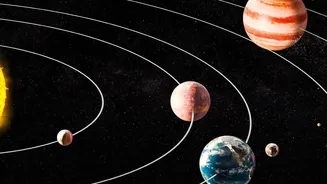
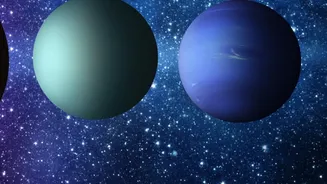
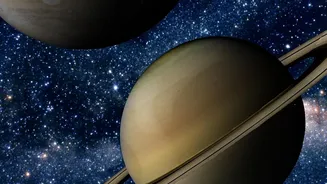
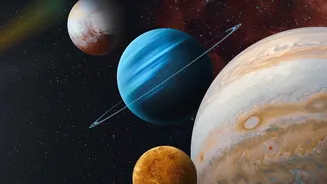
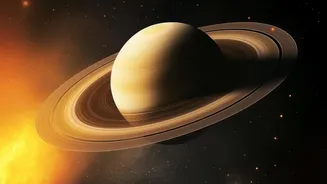
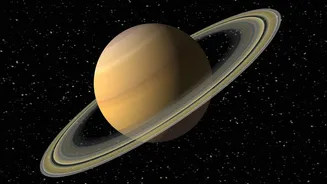
The simulations painted a wild picture of the solar system's final billion years. In some scenarios, the gravitational nudges were enough to throw the giant planets into disarray. Saturn, for example, was sometimes ejected from the solar system entirely. In other models, Uranus and Neptune swapped their orbital positions. The study found that in the most extreme mass-loss scenarios, a staggering 96% of simulated systems became unstable, leading to planetary collisions. This dramatically shortens the timeline for the solar system's stability, from potentially a quintillion years down to just a few billion years after the Sun becomes a white dwarf.
Implications Beyond Our Home
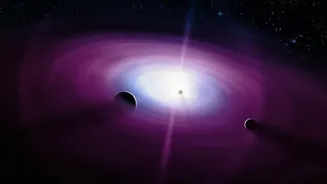
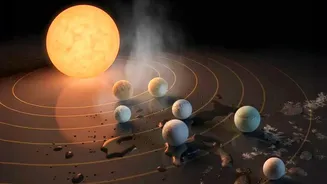
These findings have consequences that reach far beyond our own cosmic neighborhood. They suggest that planetary systems around other stars, especially those orbiting white dwarfs, may be far less stable than astronomers once assumed. The search for life on planets around these dead stars often relies on the assumption of longterm orbital stability within a habitable zone. This research suggests that such stability may be the exception, not the rule. The same mechanisms that could one day scatter our own giant planets may have already produced countless freefloating 'rogue' planets wandering through interstellar space.