
Tiny Whirlpools with Big Implications
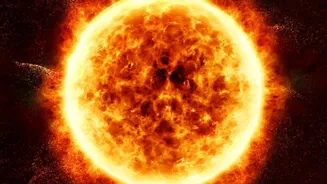
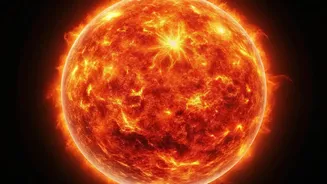
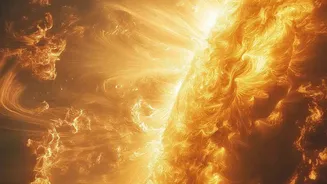
Scientists have captured the most detailed images ever of the sun's surface, revealing something long predicted but never before seen directly: tiny, swirling vortices of superheated plasma. These whirlpools, some barely 20 kilometres wide, are evidence
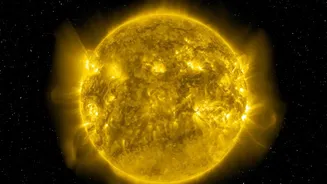
of a phenomenon known as Kelvin-Helmholtz instability. This occurs when two fluids, or in this case plasmas, move past each other at different speeds, creating a shear that curls into vortices, much like wind blowing over water. These swirls were spotted at the edges of solar granules—cauldron-like bubbles of rising hot gas that cover the sun's face. The discovery was made using the new and powerful Daniel K. Inouye Solar Telescope in Hawaii, which can resolve features on the sun with unprecedented clarity.
Solving the Coronal Heating Puzzle
For over 75 years, astrophysicists have been stumped by the coronal heating problem. The sun's visible surface, the photosphere, sits at about 6,000 degrees Celsius, yet the corona sizzles at over a million degrees. This defies the basic logic that things should get cooler the farther they are from a heat source. The newly observed plasma vortices provide a powerful new theory. Scientists believe these swirling motions twist and braid the sun's magnetic field lines, building up huge amounts of energy like a tightly coiled spring. This stored magnetic energy can then be released, transferring heat and energy up into the corona. This process could be the missing mechanism that explains the corona's extreme temperatures.
From Tiny Swirls to Solar Storms
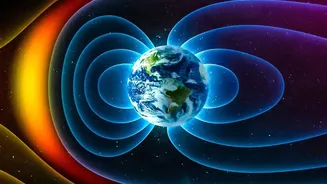
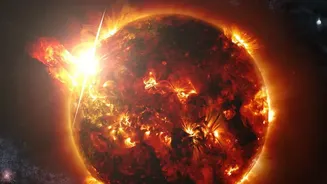
The discovery does more than just solve a long-standing academic puzzle. The twisting of magnetic fields by these small-scale vortices is believed to be the fundamental process that eventually leads to much larger and more violent solar events. By accumulating magnetic energy, these processes can build up to a point where they are suddenly released in the form of solar flares and coronal mass ejections (CMEs). These powerful explosions blast radiation and charged particles into space, creating what is known as space weather. Understanding the origin of this activity at its most basic level is a major step forward.
A New Era for Solar Physics
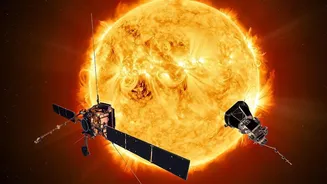
These observations mark the beginning of a new chapter in our quest to understand our star. Along with other recent findings, such as the detection of high-frequency waves by the Solar Orbiter spacecraft, scientists are building a more complete picture of the complex energy transfer system within the sun. High-frequency waves are thought to be particularly effective at depositing energy into the corona. The ability to now see these small-scale vortices provides a vital link between the motions on the sun's surface and the dramatic events in its atmosphere. This improved understanding is crucial for better predicting space weather, which can disrupt satellites, power grids, and communications on Earth. As one scientist put it, this discovery opens up whole new avenues for tackling the biggest mysteries in solar physics.