






It Turns Thought Experiments into Spectacle
At its heart, speculative science fiction is born from a powerful "what if?" question. What if we could travel through time? What if artificial intelligence developed consciousness? What if we made contact with aliens who don't perceive time linearly?
These are the kinds of questions that fuel philosophical debates and scientific hypotheses, and this genre brings them to life. Films like 'Arrival' don't just show aliens; they explore the Sapir-Whorf hypothesis, suggesting that the language we use shapes our perception of reality. 'Ex Machina' isn't merely a story about a robot; it's a tense, unsettling examination of the Turing test and the ethical maze of creating true AI. These movies take abstract concepts and give them a pulse, allowing you to engage with complex ideas in a visceral, narrative-driven way.
It Grounds Fantasy in Plausible Science
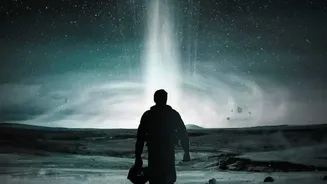
While some sci-fi leans into fantasy, the most compelling entries for a science-minded viewer are those that anchor their fantastical elements in believable rules. Good sci-fi makes science feel relatable and accessible. It's the difference between a wizard casting a spell and a spaceship crew grappling with time dilation. After watching 'Interstellar,' countless viewers found themselves diving into explanations of gravitational time dilation and wormhole theory. The film's commitment to scientific consultation makes its journey through space feel consequential and real. Similarly, 'The Martian' became a celebration of problem-solving, turning botany, chemistry, and engineering into thrilling survival tools. This grounding makes the impossible seem possible, creating a deeply satisfying viewing experience where the rules of the universe, however strange, matter.
It Challenges Our Perception of Reality
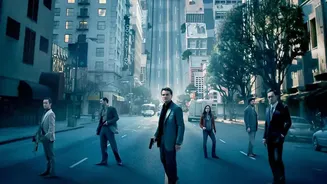
The best mind-bending sci-fi leaves you questioning everything long after the credits roll. These are films that deconstruct the very nature of consciousness, memory, and reality itself. 'Inception' is the quintessential example, creating a world with meticulously defined rules for invading dreams, making for a layered heist thriller that is also a deep dive into the subconscious. 'Blade Runner 2049' masterfully continues the original's exploration of what separates humans from artificial beings, blurring the lines with questions of memory, emotion, and the soul. Even a lower-budget, famously complex film like 'Primer' presents a stark, almost clinical depiction of time travel, forcing the audience to keep up with its tangled timelines and paradoxical consequences. These movies don't just tell you a story; they present a puzzle and invite you to solve it, making the viewing experience active rather than passive.
It Explores the Future of Humanity
Science fiction serves as a bridge between today's world and a multitude of possible futures. It often acts as a mirror, reflecting our current anxieties and hopes about technology, society, and our own evolution. A film like 'Her' speculates on the future of relationships in an increasingly digital and isolated world, asking poignant questions about love and connection when one partner is an advanced operating system. Dystopian stories, a popular subgenre, take current trends like surveillance, corporate power, or environmental neglect and extrapolate them to their logical, often terrifying, conclusions. By presenting these potential futures, these films encourage us to think critically about the path we are on. They are not just stories about robots and spaceships; they are stories about us, where we are going, and who we might become when we get there. This makes for a binge-watch that is not only entertaining but also profoundly relevant.