




Meet ChaSTE: The Moon's Thermometer
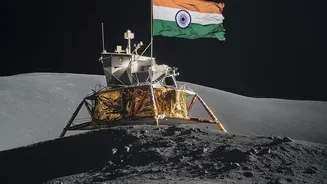
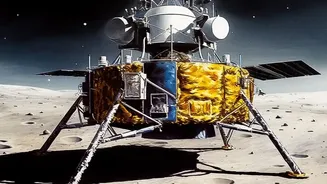
At the heart of this discovery is the Chandra’s Surface Thermophysical Experiment, or ChaSTE. Developed by the Space Physics Laboratory at Vikram Sarabhai Space Centre in collaboration with the Physical Research Laboratory (PRL), Ahmedabad, ChaSTE is a sophisticated
probe designed to do one crucial job: measure the temperature profile of the Moon's surface. It's essentially a high-tech thermometer on a 10 cm-long probe that was slowly drilled into the lunar soil, or regolith, after Vikram's successful landing. Equipped with ten precision temperature sensors and a heater, it provides the first-ever in-situ measurements of the thermal behaviour of the soil at the Moon's southern high latitudes. Its mission is to understand how the Moon’s surface absorbs and retains heat from the sun, which is critical information for planning any future lunar activity.
A Subsurface Surprise: Three Distinct Layers
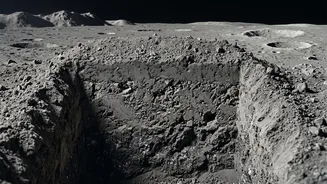
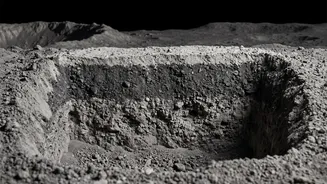
Scientists initially expected the lunar soil to be relatively uniform. However, the new analysis, published in the journal 'npj Space Exploration', paints a much more complex picture just beneath the surface at Shiv Shakti Point. The data reveals three separate layers within the top 10 cm, each with different physical and thermal properties. The first layer, extending down to about 3 cm, is a highly porous and fluffy material with a porosity of about 80% and a low density. Below that, from 3 to 6 cm, is a middle layer with higher thermal conductivity. The bottom layer, from 6 to 10 cm, is denser still, with intermediate thermal conductivity and a bulk density that increases significantly with depth. Researchers noted that this fine-scale layering was neither observed nor expected before.
How Did These Layers Form?
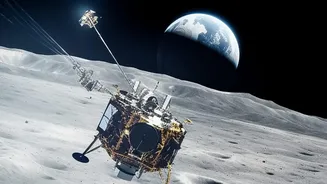
The leading theory for this unexpected layering involves a history of cosmic impacts. Researchers propose that successive meteorite impacts from nearby craters may have deposited layers of ejected material over long periods. Each impact event would have thrown out soil and rock with different characteristics, which then settled at the Chandrayaan-3 landing site, creating the stratified profile that ChaSTE detected. This geological interpretation is based on detailed modelling and analysis of the terrain surrounding Vikram's landing spot. This finding builds on earlier work from April 2026, which first identified a two-layer structure after Vikram performed a short 'hop' manoeuvre, blowing away the topsoil and exposing the layers beneath. The new analysis of the pre-hop data provides the complete, three-layer picture.
Why This Discovery Is a Game-Changer
Understanding these layers is about more than just lunar geology; it has profound implications for the future of space exploration. The properties of the lunar soil, such as its density, cohesiveness, and ability to conduct heat, are critical engineering parameters for designing future lunar habitats, landing pads, and mining equipment. For instance, the top layer's high porosity makes it a superb insulator, which could be a vital clue in the search for subsurface water ice. The data showed a dramatic temperature difference of about 73 Kelvin from the surface to a depth of 10 cm at local noon, a gradient that future equipment and astronauts will have to withstand. This detailed 'ground truth' from ChaSTE provides an invaluable dataset that will refine our models of the lunar environment and guide the design of sustainable infrastructure on the Moon.