



Meet Your New Neighbour, GJ 3378b
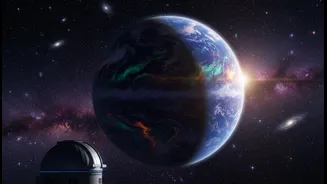
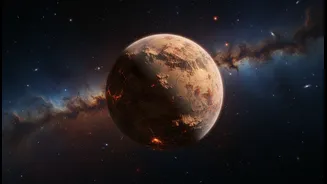
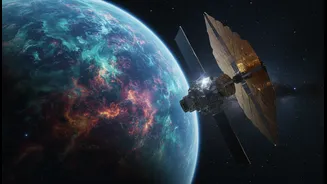
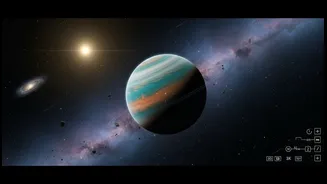
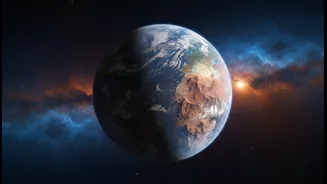
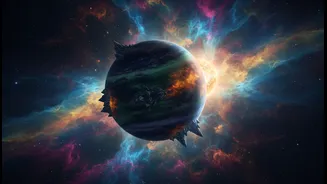
Scientists have given this not-so-distant world a name: GJ 3378b. It orbits a red dwarf star, a type of star that is much cooler and dimmer than our Sun, in the constellation Camelopardalis. This planet is what astronomers call a 'super-Earth,' meaning
it is larger and more massive than our own world but still likely to be rocky. Initial estimates of its mass have been revised downwards to about 2.3 times that of Earth, which is a crucial detail. Planets that are too massive tend to hold onto thick, crushing gas envelopes, making them more like mini-Neptunes. The lower mass of GJ 3378b makes it much more likely to have a solid, terrestrial surface like Earth.
The 'Goldilocks' Zone
What makes GJ 3378b so exciting is its location. It orbits its star within the 'habitable zone' — often called the 'Goldilocks zone'. This is the region where conditions are just right, not too hot and not too cold, for liquid water to potentially exist on a planet's surface. We know that on Earth, liquid water is a key ingredient for life. GJ 3378b receives about 90% of the energy that Earth gets from the Sun, putting it in a temperate sweet spot. Its year is much shorter than ours, completing a full orbit around its star in just over 21 days.
The All-Important Question of Atmosphere
Simply being in the habitable zone doesn't guarantee a planet is friendly to life. The biggest unknown for GJ 3378b is whether it has an atmosphere. An atmosphere is crucial for maintaining stable surface temperatures and protecting a planet from harsh space radiation. Red dwarf stars, while cool, can be very active, especially in their youth, and can blast away the atmospheres of their nearby planets. Scientists say GJ 3378b sits right on the edge of what they call the 'cosmic shoreline' — a boundary that separates planets likely to have an atmosphere from those that do not. Finding out which side of the line it falls on is the next critical step.
A Prime Target for Future Telescopes
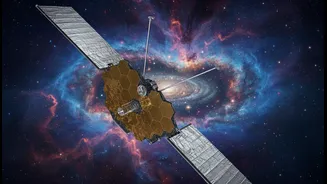
This is where the 'future target' part of the story comes in. Because GJ 3378b is relatively close to us, it’s a perfect candidate for study by powerful observatories. Telescopes like the James Webb Space Telescope (JWST) have instruments that can analyse the light from a star as it passes through a planet's atmosphere. This technique, called transmission spectroscopy, allows scientists to detect the chemical fingerprints of gases like water vapour, methane, and carbon dioxide. Detecting these molecules would not only confirm the planet has an atmosphere but could offer the first tantalizing clues about its potential to support life. Future missions, like the planned Habitable Worlds Observatory, are being designed specifically to hunt for such biosignatures on nearby rocky worlds.
Why This Discovery Matters
While there is no evidence of life on GJ 3378b, its discovery represents a significant step forward. For decades, astronomers were simply trying to find planets. Now, the search has shifted to finding the right kinds of planets and characterizing them in detail. GJ 3378b is one of the most Earth-like planets found in our cosmic neighbourhood, making it an invaluable natural laboratory. Studying it could help us understand why Earth became a haven for life while its planetary sibling, Venus, became a scorching wasteland. Every new detail we learn brings us closer to answering the ultimate question: are we alone in the universe?