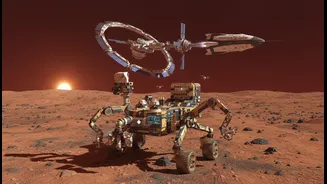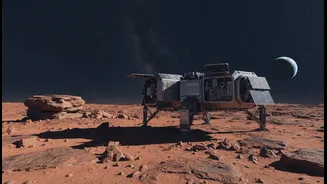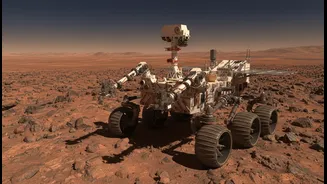




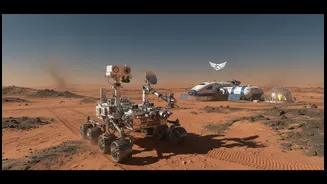
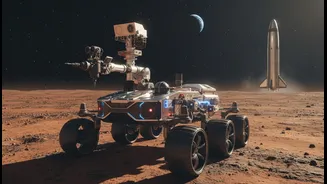



The Challenge: Mars's Final Frontiers
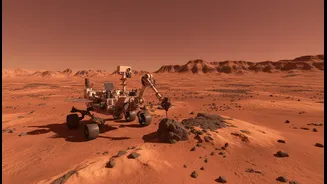
For all their incredible success, rovers like Curiosity and Perseverance have their limits. They are phenomenal at navigating plains and gentle slopes but must steer clear of steep crater walls, deep canyons, and rugged highlands. Unfortunately, these
are the very places scientists are desperate to study, as they could hold clues to Mars’s past, including evidence of ancient water and potential habitats for life. To get to these high-value scientific locations, NASA needs a new generation of robotic explorers that can go where no rover has gone before, demanding new approaches to mobility and autonomy.
The Solution: The STRIDE Initiative
Enter the Science Transport and Robotic Innovation for Deployment and Exploration (STRIDE) initiative. Announced in early July 2026, STRIDE is NASA's strategic push to partner with private industry to develop the next wave of Martian mobility. The agency has awarded contracts to seven companies, tasking them with designing innovative robotic systems that can access difficult terrain. With a total potential value of around $17 million, these contracts aren't for building full-scale rovers just yet; they are for developing concepts and maturing technologies that could one day be part of future missions. The work is slated to begin in the fall of 2026.
The Innovators: A Seven-Company Roster
NASA has spread its bets across a diverse group of established aerospace giants and nimble robotics firms. The seven companies selected are AeroVironment, Astrobotic, Venturi Astrolab, Ground Control Robotics, Honeybee Robotics, Intuitive Machines, and MEI Technologies. This mix leverages different areas of expertise, from aerial mobility pioneered by the creators of the Mars helicopter to advanced drilling, landing, and robotic arm technologies. Each company brings a unique perspective on how to solve the problem of navigating Mars, ensuring a wide range of creative solutions for NASA to consider.
AeroVironment and the Future of Flight
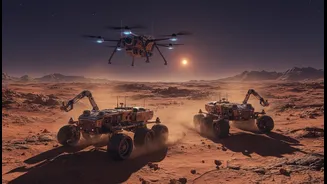
AeroVironment has a proven track record on Mars, having been a key partner in developing the revolutionary Ingenuity Mars Helicopter. Their expertise in lightweight, autonomous aerial vehicles makes them a natural choice for developing drones or flyers that could scout ahead for a rover or access high-altitude locations inaccessible from the ground. Future Mars helicopters are already being designed with capabilities to carry and retrieve sample tubes, showcasing the potential of aerial robotics.
Astrobotic & Honeybee: Masters of Surface Operations
Astrobotic and Honeybee Robotics are veterans of planetary surface systems. Astrobotic has deep experience in precision landing systems and rovers, developing technologies for navigating hazardous terrain on the Moon and Mars. Honeybee Robotics is renowned for its drills and sample acquisition tools, which have been part of multiple Mars missions, including the Curiosity and Perseverance rovers. Their work on concepts like the RedWater drill for accessing Martian ice shows their focus on getting beneath the surface. Together, their involvement points to concepts that could not only traverse but also interact with and sample the Martian environment.
The Broader Field: New and Established Players
The other awardees bring crucial capabilities. Intuitive Machines is a major player in lunar landing services, while Venturi Astrolab is focused on creating versatile planetary rovers. Ground Control Robotics and MEI Technologies round out the list, bringing fresh perspectives to the challenge. Many of these companies are also involved in NASA's Artemis program to return to the Moon, highlighting a strategy where technologies developed for the lunar surface can be adapted and proven for future Mars expeditions.
Why It Matters: The Road to Sample Return
These contracts are more than just a technology development exercise; they are a critical step toward NASA's most ambitious goals. Unlocking difficult terrain is essential for the future of Mars exploration, including the high-priority Mars Sample Return mission, which aims to bring the first pristine samples from the Red Planet back to Earth. The ability to send a robot to a specific, scientifically-compelling but hard-to-reach outcrop, retrieve a sample, and bring it to a launch vehicle is a game-changer. These STRIDE concepts could provide the missing link needed to make such a mission architecture possible.