



The Power of Infrared Light
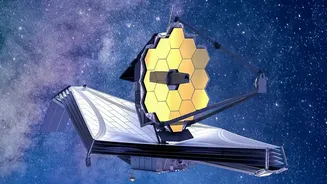
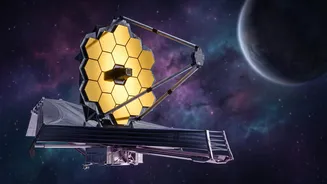
To find water on planets hundreds of light-years away, the JWST doesn't look for oceans. Instead, it looks for water vapour in a planet's atmosphere using infrared light. While our eyes see visible light, many celestial objects, including the components
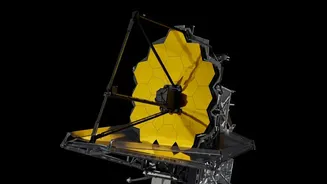
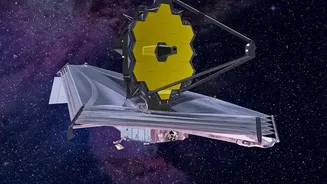
of planetary atmospheres, shine brightest in the infrared spectrum. The JWST is specifically designed to be incredibly sensitive to this type of light, which is invisible to the human eye. Its advanced instruments can pick up the faint thermal glow of distant planets and the starlight that passes through their atmospheres, holding clues to their chemical makeup.
A Technique Called Transmission Spectroscopy
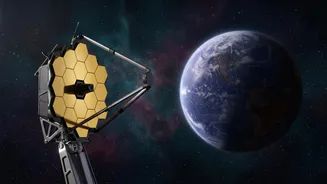
The primary method used is called transmission spectroscopy. It sounds complex, but the concept is quite elegant. Astronomers wait for an exoplanet to pass in front of its host star from our point of view—an event known as a 'transit'. As the planet transits, a tiny fraction of the starlight filters through the planet's atmosphere. The molecules within that atmosphere absorb specific wavelengths, or colours, of the light. Each molecule, whether it's water vapour, methane, or carbon dioxide, has a unique absorption 'fingerprint'. By capturing the starlight before, during, and after the transit, scientists can determine exactly what light is missing.
Reading the Atmosphere's Barcode
This missing light creates a pattern of dark lines in the star's spectrum, much like a barcode. The JWST's powerful spectrographs, like the Near-Infrared Spectrograph (NIRSpec) and the Near-Infrared Imager and Slitless Spectrograph (NIRISS), are the 'scanners' that read this barcode. These instruments spread the incoming infrared light into a rainbow-like spectrum. When water vapour is present in the exoplanet's atmosphere, it will absorb very specific frequencies of infrared light, leaving distinct dark bands in the spectrum. The presence and strength of these bands tell astronomers not just that water is present, but can also give clues about its abundance and the atmosphere's temperature.
Putting the Pieces Together
Detecting this 'barcode' is a painstaking process. The signal is incredibly faint, and astronomers must carefully distinguish the planetary signal from the star's own features, such as cooler starspots which can also contain water vapour. Scientists often need to observe multiple transits to confirm a detection and build a clear picture of the atmosphere. Instruments like the Mid-Infrared Instrument (MIRI) can provide further data on the planet's dayside to help confirm if the water is part of a stable atmosphere. Sometimes the data reveals surprises, such as the unexpected absence of methane or the presence of sand clouds, reshaping our understanding of planetary formation.
What Finding Water Vapour Means
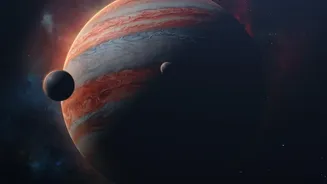
Finding water vapour is a monumental step, but it doesn't automatically mean a planet is habitable. Many planets where JWST has found water are scorching 'hot Jupiters' or have other conditions hostile to life as we know it. For example, traces of water vapour have been found on GJ 486 b, a rocky world with a surface temperature of 430 degrees Celsius. However, each detection is a crucial piece of the puzzle. It proves that a key ingredient for life exists across the galaxy and refines the techniques that will one day be used to study smaller, Earth-like planets in the habitable zones of their stars, where liquid water could potentially exist on the surface.