






A New Shape in the Heavens
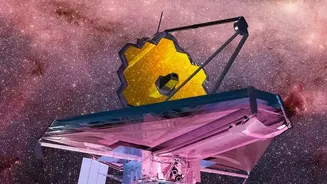
Scientists using the Hubble Space Telescope have confirmed the existence of a massive, 10-sided atmospheric wave churning around Saturn's south pole. This newly identified 'decagon' is a colossal structure, measuring approximately 104,000 miles across.
It’s not a solid object but a pattern within a powerful jet stream, a kind of standing wave in the planet's thick atmosphere. Researchers describe it as the first large, regular-sided pattern ever observed in Saturn's southern hemisphere. The discovery, detailed in the journal Science Advances in early September 2026, recasts our understanding of the ringed planet's weather, suggesting its atmosphere has a natural tendency for creating bizarre geometric storms.
The Hexagon's Mysterious Sibling
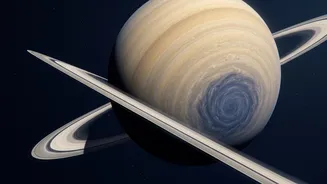
This discovery immediately draws comparisons to Saturn's most famous atmospheric feature: the hexagon at its north pole. First spotted by the Voyager spacecraft in the 1980s, the northern hexagon has puzzled scientists for decades with its near-perfect symmetry and incredible persistence. For a long time, it was considered a one-of-a-kind phenomenon. The discovery of a southern decagon changes everything. It suggests that such polygons might be a fundamental aspect of how gas giants work. However, the two shapes are not identical twins. The difference in the number of sides—six versus ten—is significant, telling scientists that the underlying conditions of the jet streams at each pole are distinct. The northern hexagon has been stable for over 40 years, while the southern decagon appears to be a new and evolving feature.
A Game of Planetary Hide-and-Seek
One of the main reasons the decagon wasn't found sooner is due to Saturn's long seasons and axial tilt. The planet's south pole was effectively hidden from Earth-based views from around 2012 until 2023. Even NASA's Cassini spacecraft, which orbited Saturn from 2004 to 2017 and provided unprecedented views of the southern hemisphere, saw no evidence of a persistent, large-scale polygon. It was only when the pole tilted back toward us that the new pattern began to emerge. The first hints appeared in images from 2023, with amateur astronomers also playing a role in tracking the feature as it became more defined through 2024 and 2025. According to researchers, the decagon appears to be strengthening, giving them a rare opportunity to watch a giant atmospheric pattern develop in near real-time.
More Than Just a Pretty Pattern
So what does it all mean? The decagon is more than a celestial curiosity; it's a key to understanding planetary atmospheres. By studying its structure, scientists have determined that it is a deep, three-dimensional wave that extends vertically through multiple cloud layers. This is similar to the northern hexagon, which is also a deep-rooted structure. The fact that Saturn can produce these geometric shapes at both poles implies a common physical mechanism is at play, even if the outcomes are different. Lead author Agustín Sánchez-Lavega of the University of the Basque Country noted that the discovery suggests the northern hexagon may not be as extraordinary as once believed. Instead, polygon-making might simply be something Saturn's atmosphere does when the conditions are right.