



An Imperfect Start, A Triumphant Recovery
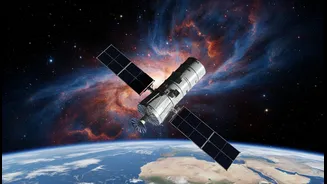
Hubble's story is one of resilience. Launched aboard the Space Shuttle Discovery in April 1990, it carried the hopes of astronomers worldwide. The promise was a view of the universe free from the distorting blur of Earth's atmosphere. However, the first
images were a devastating disappointment. A tiny flaw in its primary mirror—a spherical aberration smaller than the width of a human hair—rendered the powerful telescope effectively nearsighted. What could have been a billion-dollar failure became a tale of human ingenuity. In a daring 1993 servicing mission, astronauts installed corrective optics, essentially giving the telescope a pair of glasses. The fix worked perfectly, and the crisp, stunning images that followed marked the true beginning of Hubble's revolution.
Painting the Cosmos with Light
With its vision corrected, Hubble began to send back images that transcended science and became cultural touchstones. Perhaps none is more famous than the 1995 image of the 'Pillars of Creation,' towering columns of interstellar gas and dust in the Eagle Nebula. These celestial sculptures, stretching light-years high, showed a stellar nursery where new stars are born. The image, and others like the Hubble Deep Field—a long exposure of a tiny, seemingly empty patch of sky that revealed thousands of galaxies—fundamentally changed our perception of the cosmos. It wasn't just a black void with points of light; it was a dynamic, vibrant, and densely populated place. These images captured the public's imagination, bringing the vastness of space into living rooms and classrooms.
The Science of Wonder
Beyond the beautiful pictures, Hubble has been a relentless engine of discovery, contributing to some of the most profound breakthroughs in modern astrophysics. One of its primary missions was to pin down the expansion rate of the universe, known as the Hubble Constant. Its precise measurements helped astronomers determine the age of the universe with unprecedented accuracy, now estimated to be about 13.8 billion years. In the late 1990s, observations of distant supernovae led to a startling discovery: the universe's expansion is accelerating. This implied the existence of a mysterious, repulsive force dubbed 'dark energy,' which Hubble has continued to help scientists study. It has also proven the existence of supermassive black holes at the center of most galaxies and was a pioneer in studying the atmospheres of planets outside our solar system.
Still Going Strong in a New Era
Even after more than 30 years and with the arrival of its powerful successor, the James Webb Space Telescope (JWST), Hubble remains a vital scientific tool. In mid-2024, NASA transitioned Hubble to a new operating mode using just one gyroscope to ensure its longevity, enabling it to continue science operations for years to come. Recent observations continue to yield fascinating results. In July 2026, it captured a stunning view of an ancient star cluster, NGC 6426, providing a window into the early universe. Another recent image highlighted a stellar nursery in the Large Magellanic Cloud, offering new insights into how stars grow. Far from being replaced, Hubble now works in concert with JWST. While Webb specializes in infrared light, peering through cosmic dust to see the very first galaxies, Hubble's strength remains in visible and ultraviolet light. Together, they provide a more complete picture of the cosmos across different wavelengths.