







A Telescope Spanning Continents
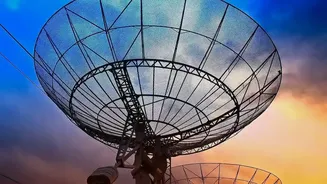
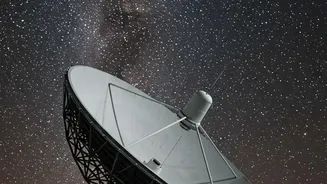
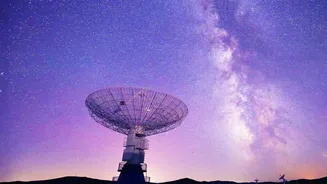
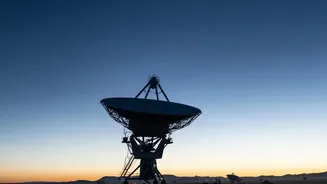
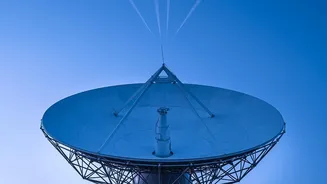
The Square Kilometre Array (SKA) is not a single telescope but an observatory operating two vast arrays on different continents. In South Africa's Karoo region, nearly 200 mid-frequency dish antennas (SKA-Mid) are being deployed to survey the sky. Meanwhile,
in the radio-quiet landscape of Western Australia, over 131,000 'Christmas tree-like' low-frequency antennas (SKA-Low) are being installed. Together, they form the world's largest and most sensitive radio telescope, a project decades in the making with construction now well underway. This global collaboration, with its headquarters in the UK, brings together nations from five continents, including India, which has been a pivotal member from the project's early days.
A Symphony of Signals
So, how do thousands of antennas spread across up to 150 kilometres function as one giant telescope? The magic is in a technique called interferometry. Each antenna in the array collects faint radio waves from space. These signals are then sent via thousands of kilometres of optical fibre to a central supercomputer. By combining the data from every antenna, the supercomputer can create an image with the same detail as one that would be produced by a single, gigantic dish the size of the entire array. The more antennas and the greater the distance between them, the more sensitive and higher-resolution the final image becomes. This requires incredibly precise timing, ensuring every signal is synchronised to within trillionths of a second to create a coherent picture of the cosmos.
Listening to the Cosmic Dawn
One of the SKA's most ambitious goals is to look back in time to the universe's infancy, a period known as the Cosmic Dawn and the Epoch of Reionisation. This era, from about 200 million to one billion years after the Big Bang, is when the very first stars and galaxies ignited, ending the cosmic 'dark ages'. These first light sources were so faint, and their light has travelled so far, that they are nearly impossible to detect with conventional telescopes. The SKA is designed to hunt for the tell-tale signature of neutral hydrogen gas, the most abundant element in the early universe, which emitted a specific radio signal at a wavelength of 21cm. As the universe expanded, this signal has been stretched to longer wavelengths, and the SKA-Low telescope in Australia is specifically tuned to detect these faint, ancient whispers.
India's Crucial Role
India has been a key player in the SKA project since its inception, with the government recently approving over ₹1250 crore for its participation. Indian scientists and engineers, coordinated by the National Centre for Radio Astrophysics (NCRA), have made vital contributions. A major achievement was leading the design of the Telescope Manager, the sophisticated software 'brain' or 'neural network' that will control and synchronise the entire observatory's operations. Now, as a full member of the SKA Observatory, India continues this leadership role and is also contributing to data processing hardware and software, with plans to host a regional data centre. This deep involvement ensures that Indian astronomers will be at the forefront of the revolutionary science the SKA will produce.