


A Storm Larger Than Our World
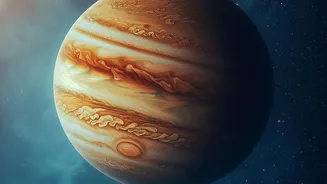
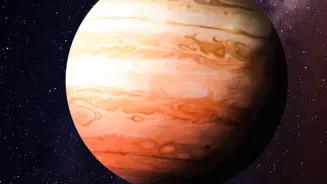
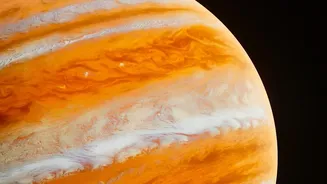
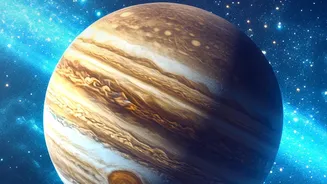
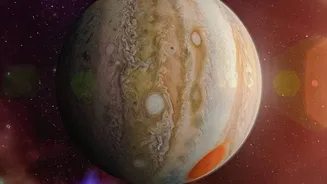
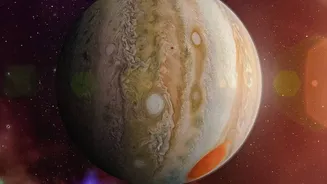
Jupiter's Great Red Spot is the most powerful storm in our solar system, a colossal anticyclone so vast it could swallow Earth whole. Astronomers have been monitoring this crimson vortex for at least 190 years, fascinated by its sheer scale and mysterious
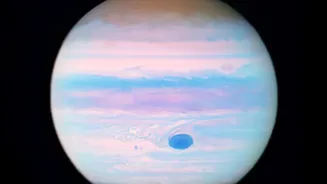
longevity. Unlike hurricanes on Earth that form over water and die out over land, the Great Red Spot has no solid surface to slow it down. It is a self-sustaining weather system, trapped between two powerful jet streams in Jupiter's southern hemisphere that have kept it spinning for generations. For a long time, it was viewed as a relatively stable, though shrinking, landmark. However, thanks to the persistent gaze of planetary cameras like those on the Hubble Space Telescope, scientists are discovering that the storm is far more complex and active than previously imagined. It is not just a spot; it's a weather system with its own internal, evolving dynamics.
A Wobble in the Giant's Eye
Recent detailed observations have provided an unprecedented look inside the storm, and the findings are surprising. Data gathered by the Hubble Space Telescope over a 90-day period showed the Great Red Spot behaving unexpectedly. Astronomers describe it as jiggling like a bowl of gelatin, oscillating in its shape. The storm was observed squeezing in and out, all while its rotational speed accelerated and decelerated over a 90-day cycle. This pulsating behaviour was a shock to scientists, who had never before had the high-resolution imaging cadence needed to spot such rapid changes. While they knew the storm was gradually shrinking and changing from an oval to a more circular shape, this rhythmic fluctuation in its size and motion is a new piece of the puzzle. These findings indicate that the forces powering this massive storm are in a constant state of flux.
The Engine Within
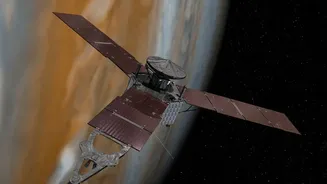
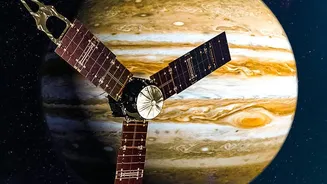
So what's causing these newly observed patterns? While a complete hydrodynamic explanation is still elusive, the data offers tantalising clues about the storm's inner workings. Earlier analysis of Hubble data from 2009 to 2020 had already revealed that the winds in the storm's outer ring were speeding up, increasing by as much as 8 percent. In stark contrast, winds near the storm's core were moving much more slowly. This suggests a complex energy exchange is happening within the vortex. Data from NASA's Juno spacecraft, using its microwave radiometer, has peered deep beneath the cloud tops, revealing that the storm has immense depth, extending as far as 350 to 500 kilometers down into the atmosphere. The storm is colder at the top and warmer at its base, a structure that likely fuels its incredible power. The wobbling and speed changes may be surface-level manifestations of deeper, unseen processes, as the storm's massive vertical structure adjusts and churns.
Clues to a Cosmic Mystery
Understanding these evolving patterns is crucial for solving the biggest mystery of the Great Red Spot: its incredible longevity. Storms of this nature should, by rights, dissipate their energy and fade over time. The fact that it has persisted for centuries means it must have a way to draw power from Jupiter's atmosphere. The new data suggests the storm is not just passively spinning but actively pulsing and changing, perhaps as part of the mechanism that keeps it alive. Studying the mechanics of the solar system's largest storm provides a cosmic laboratory for understanding planetary weather. The insights gained from Jupiter can help scientists refine their models of atmospheric physics, not just for other gas giants, but also for understanding extreme weather on Earth and even on exoplanets orbiting distant stars. Each new observation, from the subtle changes in its crimson colour to the dramatic shifts in its speed and shape, adds another piece to the portrait of this beautiful and violent atmospheric wonder.