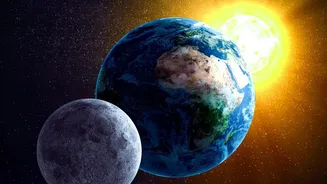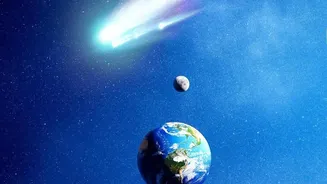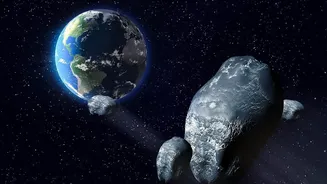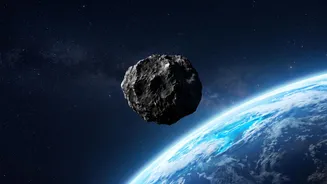


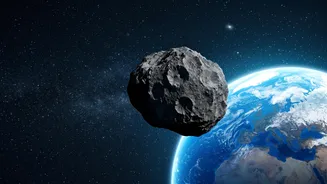
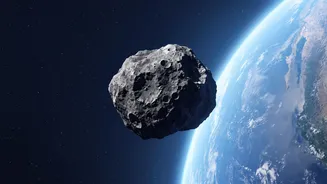
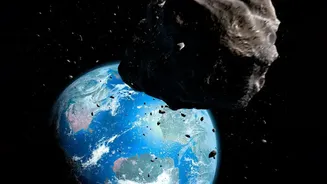
Look up. Our familiar Moon has a companion, but not for long. A tiny, car-sized asteroid has been circling our planet as a temporary 'minimoon'. Now, its time with us is coming to an end. Here is the story of our fleeting second moon.
A Fleeting Companion Bids Farewell
For the past several
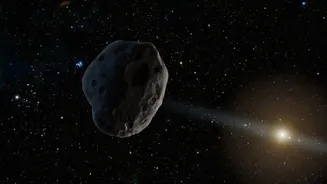
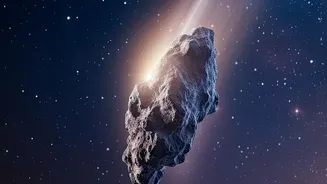
months, Earth has been unknowingly hosting a tiny visitor. An asteroid, officially designated 2026 QQ8, was captured by our planet's gravity and settled into a temporary orbit, becoming what astronomers affectionately call a 'minimoon'. This celestial hitchhiker, measuring only about two metres across, has been looping around our planet on a chaotic path far beyond our primary Moon. But its visit is drawing to a close. Soon, the gravitational pulls of the Sun and Moon that brought it here will conspire to fling it back out into space, where it will continue its lonely journey orbiting the Sun.
What Exactly Is a Temporary Moon?
The idea of a second moon might sound like science fiction, but the phenomenon is very real. The solar system is filled with debris, and as Earth moves through space, it occasionally encounters small asteroids. If one of these objects approaches our planet at a sufficiently low velocity, it can be pulled into what's known as Earth's 'Hill sphere'—the region of space where our planet's gravity dominates over the Sun's. Once inside, the asteroid becomes a temporarily captured object. These minimoons don't have stable, circular orbits like our main Moon. Instead, they follow complex, looping paths for a few months or, in rare cases, a few years before they are inevitably ejected.
The Brief, Dance of 2026 QQ8
The discovery of 2026 QQ8 was a testament to the power of modern sky surveys. These faint, fast-moving objects are incredibly difficult to detect. Most minimoons are only about a metre in diameter, and simulations suggest there could be at least one orbiting Earth at any given time, though most go completely unnoticed. Larger ones, like the two-metre 2026 QQ8, are much rarer captures. Its journey began when its orbit around the Sun brought it just close enough to Earth to be snared. For months, it has been engaged in a delicate gravitational dance, tethered to our world but constantly being tugged by the Sun. This three-body problem—involving the Earth, the Sun, and the minimoon—is inherently unstable, which is why its departure is as certain as its arrival.
Why These Tiny Moons Are a Big Deal
While 2026 QQ8 poses no threat—at its small size, it would simply burn up in the atmosphere if it ever headed our way—the study of minimoons is a fascinating frontier in planetary science. These objects are pristine samples of the solar system, delivered right to our cosmic doorstep. Unlike meteorites that are altered by their fiery passage through the atmosphere, a minimoon is an untouched piece of asteroid. Some scientists are even exploring the possibility of future robotic missions to capture a minimoon and bring it back to Earth for study. Accessing such a specimen would provide unprecedented insight into the building blocks of our solar system. Some theories even suggest that some of these minimoons could be fragments of our own Moon, blasted into space by ancient impacts.