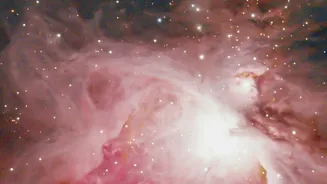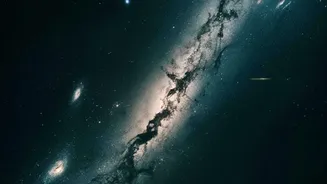


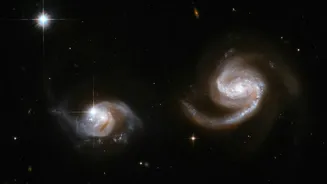
We think of telescopes as cosmic cameras, capturing stunning photographs of distant galaxies. But what if a telescope could 'see' without taking a picture at all? This is the world of radio astronomy, where scientists listen to the universe's secrets.
Listening to Invisible Light
The universe is awash with light, but our eyes can only perceive a tiny fraction of it, known as the visible spectrum. Beyond the reds and violets lies a vast range of electromagnetic waves, including the very long wavelengths of radio waves. Planets, stars, black holes, and vast clouds of gas all emit these radio waves naturally. A radio telescope acts like a giant, specialized antenna, designed to collect these faint signals from space, revealing a universe that is completely invisible to traditional optical telescopes. They can even operate during the day and are unaffected by clouds or rain, which block visible light.
A Giant Bucket for Radio Waves
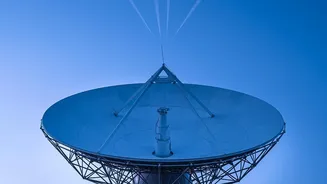
A radio telescope's large, curved dish works like a massive bucket. Its primary job is not to focus light to a single point for a photo, but to collect and concentrate extremely weak radio waves onto a central receiver, or radiometer. These signals are a billion billion times weaker than what your cell phone picks up, so size matters. The larger the dish, the more signals it can collect and the fainter the objects it can detect. A single-dish telescope typically captures information from just one 'pixel' in the sky at a time. To build an image, it must slowly scan back and forth across a region of space, recording the signal strength from each point. This process is methodical but time-consuming.
The Power of Teamwork: Interferometry
To create the stunningly detailed radio images we often see, astronomers use a technique called interferometry. This involves linking multiple radio dishes, sometimes spread across continents, to work together as a single, virtual telescope. Each pair of antennas in the array is called a 'baseline'. By combining the signals from each baseline, astronomers can simulate a telescope as large as the maximum distance between the individual dishes. This allows for incredibly high resolution, enabling them to see fine details that a single, city-sized dish could otherwise only achieve. The Earth's rotation is also cleverly used; as our planet turns, it changes the orientation of the array relative to the cosmic source, helping to fill in more data and create a more complete image in a process called Earth-rotation aperture synthesis.
Painting a Picture with Data
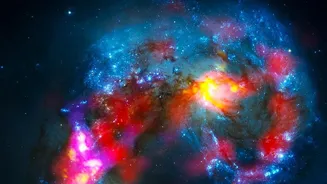
The signals gathered by the telescopes are not pictures but streams of numbers representing the intensity and properties of the radio waves. These massive datasets, sometimes petabytes per day, are fed into powerful supercomputers. The computer acts as the 'lens', using complex mathematical processes like Fourier transforms to combine the data from all the antennas and reconstruct an image. The colors you see in the final images are 'false colors'. Astronomers assign different colors to represent various characteristics of the radio signal, such as its strength, frequency, or polarization. Red might show intense emissions, while blue could represent weaker ones, allowing scientists to visually interpret the complex physics of a celestial object.
Unveiling a Hidden Cosmos
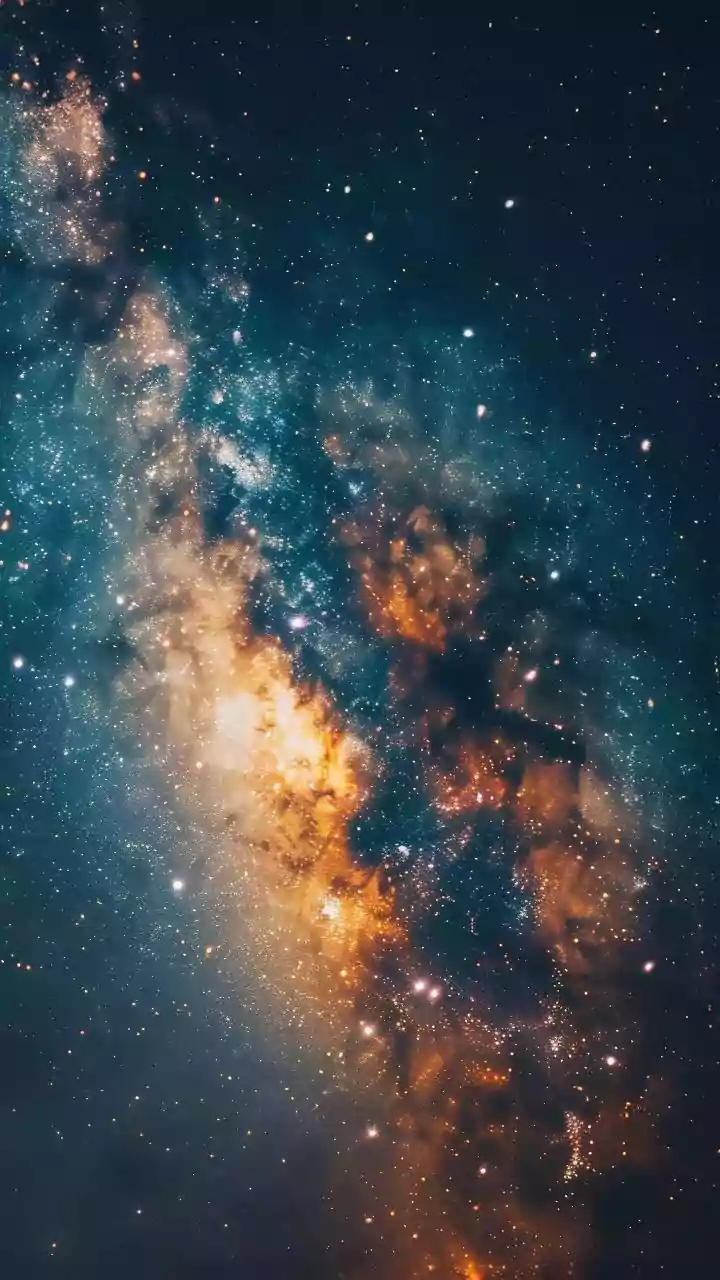
This unique way of 'seeing' has revolutionized our understanding of the universe. Radio waves can pass straight through the dense clouds of cosmic dust and gas that block visible light, allowing us to peer into the hearts of star-forming regions and the center of our own Milky Way galaxy. Radio astronomy led to the discovery of entirely new classes of objects, including pulsars (the spinning remnants of dead stars), quasars (incredibly energetic objects powered by supermassive black holes), and the faint afterglow of the Big Bang itself, known as the cosmic microwave background. It provides a vital, complementary view to optical telescopes, probing the cold, the old, and the most extreme processes in the universe.