
Whirlpools on the Sun
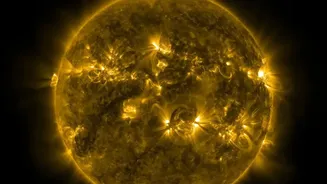
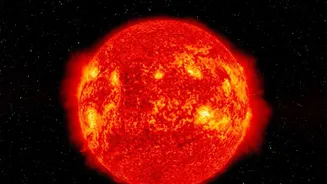
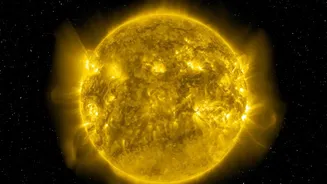
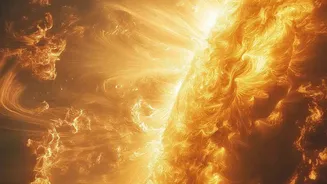
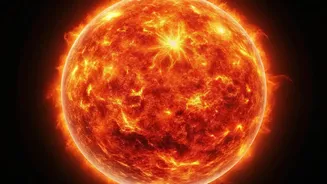
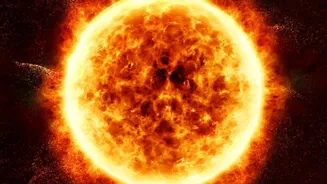
In a breakthrough observation, scientists have captured the most detailed images of the Sun’s surface ever taken. These images revealed something that had been theorised but never seen directly: tiny, swirling vortices of plasma, some as small as 20 kilometres
across. Known as Kelvin-Helmholtz instabilities, these whirlpools form where hot, electrically charged gas (plasma) moves at different speeds, creating a shearing effect similar to how wind creates waves on water. Using the powerful Daniel K. Inouye Solar Telescope in Hawaii, researchers were able to spot these dynamic structures churning at the edges of the Sun’s magnetic regions, acting like tiny engines on the solar surface.
The Coronal Heating Puzzle
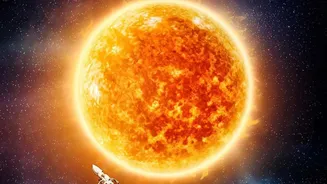
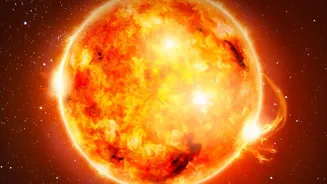
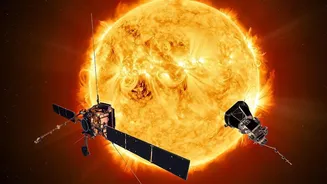
This discovery is a massive clue in solving what scientists call the 'coronal heating problem'. It’s a puzzle that has stumped astrophysicists for decades. The Sun's visible surface, or photosphere, clocks in at a relatively cool 5,500 degrees Celsius. Logic would suggest that as you move away from a heat source, the temperature should drop. Yet, the Sun's outer atmosphere, the corona, sizzles at a staggering one million degrees Celsius or more. How does energy bypass the cooler surface layer to superheat the atmosphere above it? It’s a question that has driven solar science, leading to the development of powerful new telescopes and space missions designed to find the missing link.
An Upward Energy Escalator
The newly seen plasma vortices appear to be that missing link, or at least a crucial part of it. Scientists believe these small-scale swirls provide a mechanism for pumping vast amounts of energy from the surface up into the corona. As the plasma churns in these whirlpools, it twists and braids the Sun’s magnetic field lines, which extend from the surface far out into the atmosphere. This twisting action effectively stores and channels energy upwards. Think of it like winding up a rubber band; the vortices are the twisting motion, and the magnetic field lines are the band storing that potential energy. When that energy is released high up in the corona, it could provide the heat needed to explain the extreme temperatures.
Predicting Solar Storms
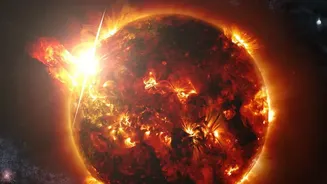
Beyond solving a fundamental mystery about our star, this discovery has practical implications here on Earth. The same process of twisting and tangling magnetic fields is what fuels powerful solar events like solar flares and coronal mass ejections (CMEs). When these tangled magnetic fields suddenly snap and reconfigure, they can unleash a torrent of energy and charged particles into space. If aimed at Earth, this 'space weather' can disrupt satellites, damage power grids, and endanger astronauts. By understanding the small-scale 'motors' like these vortices that load the magnetic 'gun', scientists hope to build better models for predicting when and where these larger, more destructive solar storms might occur.