



The Problem with 'Almost' Finding Life
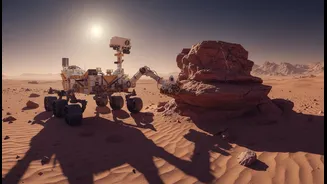
For decades, the search for extraterrestrial life has been haunted by ambiguity. In 1976, the Viking landers on Mars returned results that, at first glance, hinted at metabolic activity in the soil. Decades later, a Martian meteorite, ALH84001, revealed
structures that looked tantalizingly like fossilized microbes. In both cases, excitement gave way to debate and, ultimately, uncertainty. Non-biological chemical reactions could explain the Viking results, and geological processes could have created the shapes in the meteorite. This history of near-misses and false alarms has taught the scientific community a hard lesson: a single, ambiguous clue is not enough. Extraordinary claims require extraordinary evidence, and announcing the discovery of alien life based on a reading that could be a fluke would be a monumental error, undermining public trust and derailing serious scientific inquiry.
Raising the Bar for Proof
To avoid repeating past mistakes, NASA scientists have introduced a new framework to standardize how potential evidence for life is evaluated and communicated. Known as the Confidence of Life Detection (CoLD) scale, it establishes a seven-level ladder of certainty. The scale starts at level one with the detection of a possible signal and ends at level seven with independently confirmed evidence of life. Moving up the ladder requires ruling out contamination, showing the local environment can support life, and, crucially, detecting multiple, independent lines of evidence. The goal is to shift away from a single “smoking gun” and toward building a comprehensive, undeniable case. This disciplined approach ensures that findings are communicated with appropriate context, preventing small steps from being sensationalized as giant leaps. It forces researchers to consider all possible non-biological explanations before even suggesting life as the answer.
The Allure of Icy Ocean Worlds
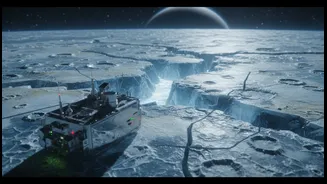
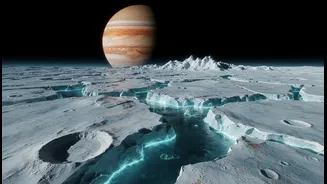
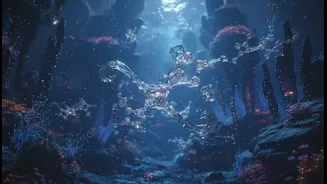
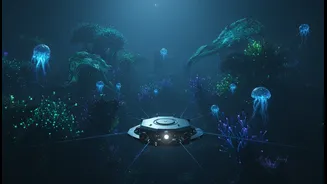
This new-found rigor is especially critical as attention turns to the most promising places to find life in our solar system: the ocean worlds. Moons like Jupiter’s Europa and Saturn’s Enceladus are thought to harbor vast liquid water oceans beneath their icy shells. Evidence suggests these oceans are in contact with rocky seafloors, potentially creating hydrothermal vents similar to those on Earth where life thrives without sunlight. Enceladus even shoots plumes of water vapor and ice grains into space, offering a tantalizing opportunity for a passing spacecraft to sample its ocean without ever having to land. These worlds have the three key ingredients for life as we know it—liquid water, a source of energy, and the right chemical building blocks. But the very processes that make them habitable can also create chemistry that mimics life, making the risk of a false positive extremely high.
A New Question for Mission Planners
These stricter standards present a profound new question for those designing the next generation of space probes: how do you build a mission that can satisfy these rigorous demands? It’s no longer enough to send a single instrument to look for one type of biosignature. A future mission to Europa or Enceladus must be a mobile, multi-talented laboratory. It will need a suite of instruments capable of detecting different types of evidence—for example, complex organic molecules, unexpected ratios of isotopes, and microscopic structures—and then cross-validating the findings. This makes mission design exponentially more complex and expensive. Planners must now ask what combination of measurements would be sufficient to climb the CoLD scale. Should a lander drill beneath the radiation-blasted surface, and if so, how deep? Is it better to analyze plume particles on the fly, or is a sample-return mission, despite its complexity, the only way to get a definitive answer?