








The Legend of the Seven Pagodas
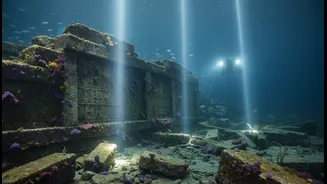
The story of Mahabalipuram, a UNESCO World Heritage site in Tamil Nadu, is incomplete without the myth of the Seven Pagodas. Early European sailors and travelers used this name, referring to a local tradition that the grand temple visible on the coast
was not alone. Legend holds that a once-glorious city with six other temples was submerged by the Bay of Bengal, an act attributed to the wrath of the gods or the slow, unforgiving march of the sea. For generations, this was considered little more than romantic folklore—a fascinating tale to tell tourists against the backdrop of the Pallava dynasty's stunning 8th-century rock-cut monuments. Fishermen occasionally spoke of glimpsing ruins beneath the waves, but concrete proof of a lost city remained elusive, filed away as a captivating local myth.
A Tsunami's Shocking Revelation
The tragic Indian Ocean tsunami in December 2004 brought an unexpected and dramatic turn to this age-old story. In the moments before the massive waves struck the coast, the sea receded by as much as 500 meters. Eyewitnesses on the shore were stunned to see long, straight rows of large rocks and what appeared to be the ruins of walls emerge from the seabed, before being engulfed once more. The powerful tsunami also scoured away centuries of accumulated silt from the ocean floor and the coastline. In its devastating wake, it left behind newly exposed statues, including a large stone lion, and the foundations of previously unknown structures on the beach, lending sudden, tangible weight to the old legends.
From Myth to Marine Archaeology
The tsunami-exposed evidence catalysed a new era of scientific investigation. In the years that followed, the Archaeological Survey of India (ASI) and the National Institute of Oceanography (NIO), with assistance from the Indian Navy, launched systematic underwater explorations. Using sonar technology, they mapped the seabed off the coast. The results were astounding. They found what the eyewitnesses had glimpsed: submerged walls, some as long as 70 metres, along with scattered stone blocks, flights of stairs, and remains of what appeared to be at least two other temples. These structures were found at depths of 5 to 8 meters, located up to 800 meters from the current shoreline, suggesting a significant portion of the ancient town had indeed been lost to the sea.
The Search Resumes with New Technology
After a hiatus of nearly two decades, the quest has been reignited. In late 2025, the ASI's Underwater Archaeology Wing (UAW) resumed its fieldwork off the Mahabalipuram coast, determined to build on the earlier discoveries. This new phase of exploration is powered by significant technological advancements. The team is now equipped with a sophisticated Remotely Operated Vehicle (ROV). This underwater drone can capture high-resolution imagery and video of submerged remains in challenging marine environments without physically disturbing the fragile archaeological site. This technology allows for more precise and safer exploration, enabling researchers to probe deeper and document findings with unprecedented clarity, hoping to finally solve the riddle of the submerged Pallava-era complex.
What a Discovery Would Mean
Confirming the existence of a large, submerged temple complex would be a monumental discovery for Indian archaeology and history. It would transform a cherished legend into documented fact, providing invaluable insights into the Pallava dynasty, their architectural prowess, and the historical coastline. Some findings even point to structures that pre-date the Pallavas, potentially from the Sangam period, which would rewrite our understanding of the area's ancient past. Beyond its academic importance, uncovering a lost city would capture the imagination of the world, much like the discoveries of Pompeii or Troy. It would enhance Mahabalipuram's standing as a premier cultural heritage site and stand as a powerful testament to the marriage of ancient lore and modern scientific inquiry.