


A Tiny New Neighbour
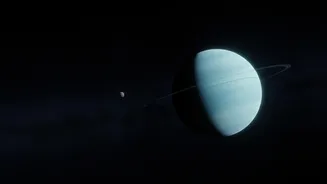
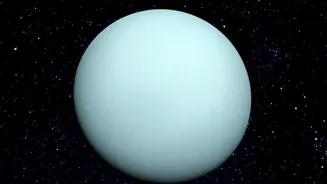
Astronomers have confirmed the discovery of a new moon orbiting Uranus, the first to be found in over two decades. Provisionally named S/2023 U1, this celestial body is remarkably small, estimated to be only about 8 kilometres in diameter, likely making
it the smallest of Uranus’s 28 known moons. It was first spotted in late 2023 using the powerful Magellan telescopes in Chile. The discovery was so challenging that it required special image processing techniques just to reveal the faint object against the blackness of space. This new addition will eventually be named after a character from a Shakespeare play, following the tradition for Uranian satellites.
An Orbit Like No Other
What makes S/2023 U1 truly fascinating is its orbit. It is classified as an "irregular moon" because its path is distant, highly elliptical, and steeply inclined compared to Uranus's larger, more orderly moons. It takes this tiny world a staggering 680 Earth days to complete a single journey around the ice giant. Furthermore, its orbit is retrograde, meaning it travels in the opposite direction to Uranus's own rotation. This type of orbit suggests that S/2023 U1 was not born alongside Uranus from the same disk of gas and dust. Instead, it was likely a wandering object from the outer solar system that was captured by the planet's immense gravity billions of years ago.
A Clue to a Violent Past
The orbital behaviour of S/2023 U1 is more than just a curiosity; it's a vital clue for understanding the history of our solar system. Its orbit is dynamically similar to two other irregular Uranian moons, Caliban and Stephano. Astronomers believe this isn't a coincidence. This grouping suggests that all three may be fragments of a much larger parent moon that was shattered by a cataclysmic collision with a comet or asteroid in the distant past. By studying these orbital families, scientists can piece together a history of cosmic impacts that shaped the outer planets. This helps them model the chaotic and violent early years of the solar system when planets were still migrating and debris was flying everywhere.
Why This Discovery Matters
Finding a moon as small and distant as S/2023 U1 is a testament to modern astronomical technology and persistence. The faintness of the moon pushed the limits of even ground-based telescopes. More importantly, the discovery reinforces a key theory: that all the giant planets in our solar system, regardless of their size or orientation, collected their outer moons in a similar fashion—by gravitational capture. Even Uranus, which is famously tilted on its side, has an outer moon system that resembles those of Jupiter, Saturn, and Neptune. This uniformity provides a crucial baseline for understanding planet formation not just in our solar system, but in planetary systems across the galaxy. Each new irregular moon helps refine models of how these systems form and evolve.