





A Tale of Two Oxygens
At the heart of this climate detective story are two types of oxygen atoms, known as isotopes. All oxygen atoms have 8 protons, but they can have a different number of neutrons. The most common type is the lighter Oxygen-16 (¹⁶O), with 8 protons and 8 neutrons. A much
rarer, heavier version is Oxygen-18 (¹⁸O), which has two extra neutrons. While chemically identical, this tiny difference in weight is the key to unlocking ancient climate secrets. Water molecules (H₂O) can contain either ¹⁶O or ¹⁸O. Because water with ¹⁸O is heavier, it requires more energy to evaporate from the ocean's surface and condenses more easily than its lighter counterpart. This simple fact of physics governs how the two isotopes are distributed around the planet.
From Ocean to Ice Sheet
The journey of these isotopes is dictated by the global water cycle. Water evaporates from the warm oceans, mostly in the tropical and subtropical regions. Because lighter ¹⁶O water evaporates more easily, the water vapour that rises into the atmosphere is slightly enriched with ¹⁶O. As this air travels towards the cold polar regions, it begins to cool. The heavier ¹⁸O water condenses and falls as precipitation at lower latitudes first, further depleting the air mass of the heavy isotope. By the time the air reaches the frigid poles, it is significantly poorer in ¹⁸O. This water vapour then falls as snow, which over centuries gets compressed into glacial ice.
Reading the Frozen Thermometer
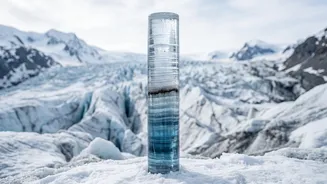
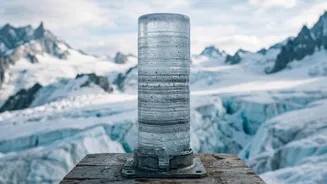
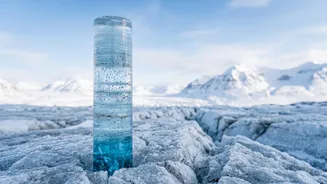
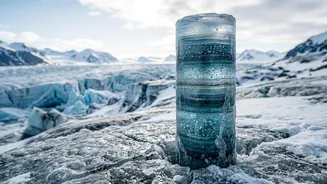
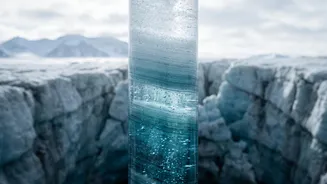
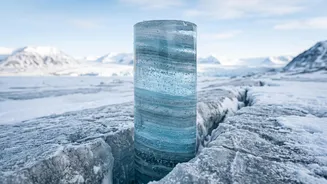
This process creates a direct link between temperature and the isotope ratio found in polar ice. During colder global periods, like an ice age, the temperature difference between the tropics and the poles is more extreme. This makes the process of 'raining out' the heavy ¹⁸O even more efficient. Consequently, the snow that falls on the poles during cold eras is exceptionally low in ¹⁸O. Conversely, during warmer interglacial periods, more energy is available, allowing more of the heavier ¹⁸O to be carried all the way to the poles. So, when scientists drill deep into an ice sheet, they can analyze the ¹⁸O/¹⁶O ratio in each layer. A lower ratio indicates a colder past temperature, while a higher ratio points to a warmer climate. This relationship is so predictable that it acts as a reliable temperature 'proxy'—an indirect measure of past conditions.
Dating the Layers of Time
Of course, knowing the temperature is only useful if you know when that temperature occurred. Scientists use several methods to date the ice cores. In the upper layers, distinct seasonal differences in snow accumulation can be counted like tree rings, often going back tens of thousands of years. Deeper down, where the layers are more compressed, researchers rely on other markers. Layers of volcanic ash trapped in the ice can be matched to known eruptions of specific dates. Scientists can also use radioactive dating on certain elements found in trapped dust or analyze the composition of ancient air bubbles preserved in the ice, which contain greenhouse gases that can be linked to other climate records.