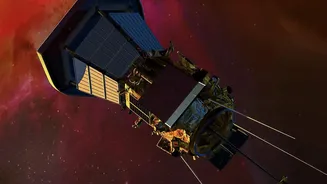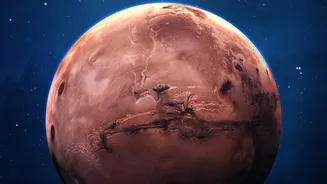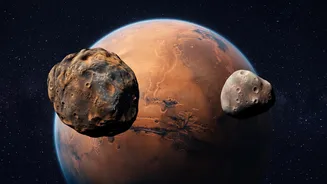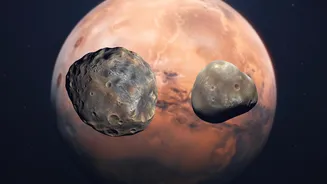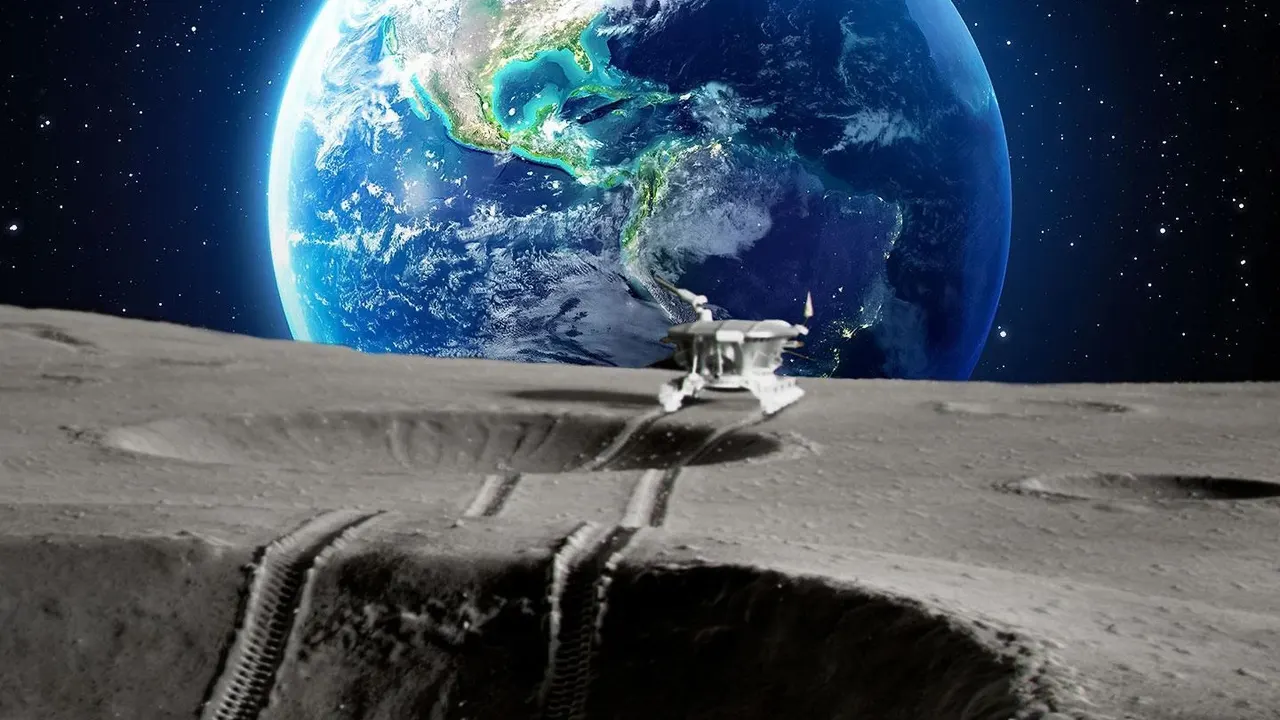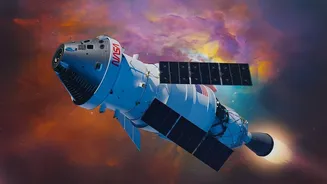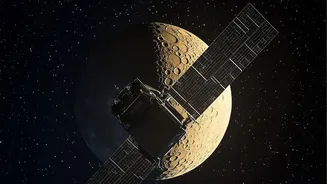







NASA is once again reaching for the cosmos, this time by contributing a key piece of technology to an ambitious international mission. The goal? To unlock the secrets of Mars's enigmatic moon, Phobos, using a powerful new set of cosmic 'eyeglasses'.
A New Set of Cosmic Eyes
The
instrument at the heart of this endeavour is MEGANE, which stands for Mars-moon Exploration with GAmma rays and NEutrons. Pronounced 'meh-gah-nay', the name is also the Japanese word for eyeglasses, a fitting description for a device designed to 'see' the elemental composition of a celestial body. Developed by a team at the Johns Hopkins Applied Physics Laboratory (APL) in partnership with Lawrence Livermore National Laboratory, MEGANE is NASA's primary contribution to the mission. It consists of a state-of-the-art gamma-ray spectrometer and a neutron spectrometer. Together, these tools will map the elements that make up the surface of Phobos, providing unprecedented insight into what the moon is made of.
The MMX Mission to Phobos
MEGANE is one of several instruments aboard the Martian Moons eXploration (MMX) spacecraft, a mission led by the Japan Aerospace Exploration Agency (JAXA). The MMX probe launched successfully from Japan on October 20, 2026, beginning its long journey to the Red Planet. It's expected to arrive in orbit around Mars in August 2027. The primary goal of the mission is to solve a long-standing mystery about Mars's two small moons, Phobos and Deimos. After studying both moons, the MMX spacecraft will land on Phobos, collect at least 10 grams of surface material, and return it to Earth for analysis. If successful, this will be the first-ever sample return mission from the Martian system, with the precious cargo expected to arrive in 2031.
Hunting for Clues in Cosmic Rays
So how do gamma rays and neutrons reveal a moon's composition? The surface of Phobos is constantly bombarded by high-energy cosmic rays from deep space. This cosmic radiation interacts with the elements in the moon's surface, causing them to emit their own signature gamma rays and neutrons. The MEGANE instrument is precisely tuned to detect these emissions. By measuring the energy levels of the particles, scientists can create a detailed map of elements like oxygen, silicon, iron, and, crucially, hydrogen. Finding hydrogen is a strong indicator of the presence of water ice, a vital resource for future exploration and a key clue to a celestial body's past.
An Asteroid or a Piece of Mars?
The data collected by MEGANE will help scientists answer a fundamental question: is Phobos a captured asteroid, or is it a piece of Mars itself, blasted into orbit by a giant impact millions of years ago? Each origin story would result in a different elemental composition. An asteroid would likely have a composition similar to meteorites found on Earth, perhaps rich in carbon and water. If Phobos is made from the crust of Mars, its composition would be very different, reflecting that of the Red Planet. Determining which scenario is correct will not only solve the riddle of Mars's moons but also provide invaluable insights into how planets and solar systems form. The instrument's findings will also help the MMX team select the best possible site for its historic sample collection.
An International Leap for Science
The MMX mission is a prime example of modern, collaborative space exploration. While led by Japan's JAXA, it features significant contributions from NASA, including the MEGANE instrument and navigation support from the Deep Space Network. France and Germany's space agencies have contributed a small rover named Idefix that will land on Phobos to study its surface properties before the main spacecraft attempts to collect its sample. This global partnership pools resources and expertise to tackle ambitious scientific goals that might be too complex for any single nation to achieve alone. For space enthusiasts in India, it mirrors the collaborative spirit seen in many of ISRO's own missions, highlighting a global trend toward working together to unravel the mysteries of our solar system.