


A Dusty Neighbourhood
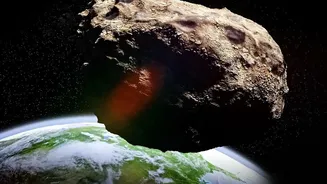
Our solar system is a dynamic and surprisingly messy place. The space between the planets, particularly the inner region where Mercury, Venus, Earth, and Mars reside, is constantly being supplied with a fine powder of cosmic dust. This isn't primordial
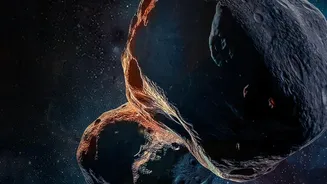
material left over from the solar system's birth 4.6 billion years ago; that was cleared out long ago. Today's dust is a 'later-generation' product, continuously generated by two main sources: the slow disintegration of comets as they are warmed by the Sun, and collisions between asteroids in the vast belt between Mars and Jupiter. These events release countless tiny particles, ranging in size from microscopic grains to particles smaller than the width of a human hair, which then begin a complex journey through space. While this dust is spread thinly, it's enough to be visible from Earth as the 'zodiacal light' — a faint, ethereal glow seen after sunset or before sunrise.
The Sun’s One-Two Punch
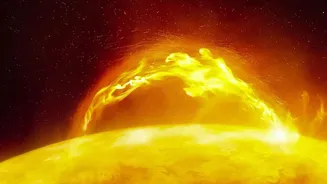
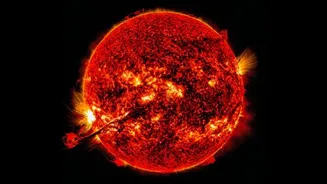
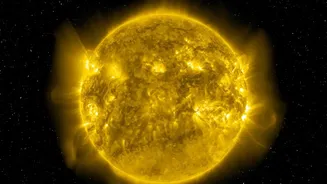
If this dust were only governed by gravity, our inner solar system would look very different, perhaps with dense rings like Saturn's. But the Sun exerts more than just a gravitational pull; it actively pushes back with two distinct, powerful forces that work together to clear the space around it. The first is radiation pressure, the physical push of sunlight itself. The second is the solar wind, a relentless stream of charged particles flowing outwards from the Sun at incredible speeds. For the smallest dust particles, these forces are a gale-force wind that can overcome the Sun’s gravity and sweep them out of the solar system entirely. For slightly larger particles, the process is more subtle, but the end result is often the same: removal from the interplanetary neighbourhood.
Force 1: The Push of Light
It may sound like science fiction, but light itself can push things. Every photon, or particle of light, carries a tiny amount of momentum. When a photon strikes a dust particle, it transfers that momentum, giving the particle a minuscule nudge away from the Sun. While one photon has a negligible effect, the Sun bombards these dust grains with an unceasing torrent of them. For the very smallest dust particles, often called 'beta meteoroids', the cumulative push from this radiation pressure is stronger than the Sun's gravitational pull. These particles are effectively blown out of the solar system, ejected into interstellar space on hyperbolic orbits. This process is highly dependent on the particle's size and surface area-to-mass ratio; it’s like the difference between wind pushing a pebble versus a feather.
Force 2: The Solar Wind's Gust
The solar wind is a different beast altogether. It's not light, but a plasma — a superheated stream of protons and electrons constantly flowing from the Sun's corona at speeds up to two million kilometres per hour. This isn't like a gentle breeze; it's a continuous, high-speed flow of matter that physically slams into anything in its path. Just as it strips atmospheres from unprotected planets like Mars over aeons, the solar wind collides with interplanetary dust particles. This impact imparts kinetic energy, pushing the dust grains and contributing to the overall outward force they experience. The solar wind essentially acts in concert with radiation pressure, providing an additional shove that helps to 'sandblast' the inner solar system clean.
The Slow Spiral of Death
While the tiniest particles are blown out, slightly larger (but still microscopic) dust grains face a different fate due to a more complex phenomenon called the Poynting-Robertson effect. This effect also stems from solar radiation but acts as a drag force. As a dust particle orbits the Sun, it absorbs sunlight from a slightly forward direction due to its own motion—similar to how running through rain makes your front get wetter than your back. This creates a tiny but persistent braking force that causes the particle to lose orbital energy and angular momentum. Instead of being pushed out, the particle slowly spirals inward on a journey that can take thousands of years. Eventually, this death spiral concludes as the particle gets close enough to the Sun to be vaporized, providing a final, definitive cleanup of the debris.