


The Million-Degree Mystery
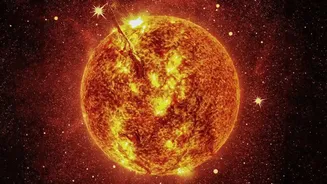
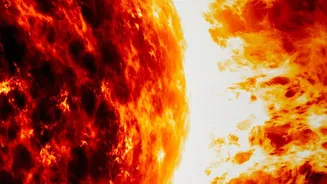
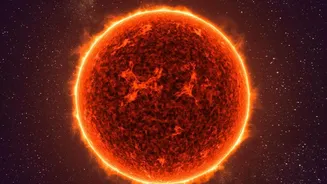
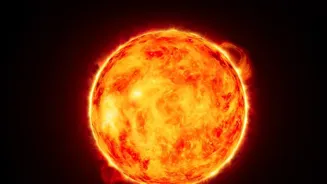
Imagine standing by a bonfire and feeling the air get hotter the further you walk away. It defies logic, but that is precisely what happens on the sun. Its visible surface, the photosphere, simmers at a relatively cool 5,500 degrees Celsius. Yet, its
outer atmosphere, the corona, which is visible as a ghostly halo during a total solar eclipse, blazes at temperatures of one million degrees or more. This phenomenon, known as the coronal heating problem, has baffled astrophysicists since the 1940s. Basic laws of thermodynamics suggest the corona should be cooler than the surface, not 200 times hotter, meaning some unknown process must be pumping tremendous energy into the tenuous upper atmosphere.
Searching for a Hidden Engine
Scientists have long suspected the sun's powerful and complex magnetic field is the key. One of the leading theories involves magnetohydrodynamic waves, a type of wave that travels through plasma, the superheated, electrically charged gas that makes up the corona. A specific type, called Alfvén waves, were first predicted by Nobel laureate Hannes Alfvén in 1942. The theory goes that these waves are generated by the churning motions on the sun's surface, travel up along magnetic field lines, and then deposit their energy as heat in the corona. For decades, however, direct evidence of waves carrying enough energy, particularly high-frequency ones, remained elusive.
A Breakthrough Observation
Recent findings from the European Space Agency's Solar Orbiter have provided a crucial piece of the puzzle. Using its high-resolution Extreme Ultraviolet Imager (EUI), scientists detected a previously unseen population of abundant, rapid, high-frequency transverse waves in the sun's corona. These observations, with a cadence far faster than previous instruments, revealed wave events with periods shorter than 100 seconds. These fast-oscillating waves were observed in coronal plumes over the sun's polar regions, which act like natural channels guiding energy out into space. The energy carried by this newly discovered population of waves is significantly higher than that seen in slower waves, providing a powerful new candidate for the corona's mysterious heat source.
How the Waves Deliver the Heat
A wave doesn't heat an atmosphere just by passing through it; its energy must be converted into heat. Scientists believe this happens through a process of turbulence. As the high-frequency Alfvén waves travel outwards, they can interact, reflect, and break down, creating a chaotic cascade of energy at smaller and smaller scales. This turbulence effectively 'stirs' the plasma, causing the energy of the organized wave to dissipate into the random, chaotic motion of particles—which is, by definition, heat. Other recent observations have also captured the first direct evidence of small-scale torsional, or twisting, Alfvén waves, which had been theorized for over 80 years and are another key ingredient in this heating mechanism.
One Step Closer to a Solution
This discovery of high-frequency waves does not completely solve the coronal heating problem on its own, which scientists now see as a family of connected issues. However, it provides the strongest evidence yet for the wave heating theory, filling in a major gap regarding where the necessary energy could be coming from. Understanding this process is not just an academic exercise. The same mechanisms that heat the corona also drive the solar wind, the stream of charged particles that flows from the sun and can impact Earth. This affects our satellites, communication systems, and power grids, a phenomenon known as space weather. By getting closer to solving the sun's heating mystery, we also improve our ability to predict and prepare for these cosmic events.