




A Frozen Time Capsule Beyond Neptune
To understand this discovery, we first have to travel to the frigid, dark outer reaches of our solar system. Beyond the orbit of Neptune lies the Kuiper Belt, a vast, doughnut-shaped ring of icy bodies. Think of it as a cosmic deep freeze, preserving
remnants from the dawn of the solar system over 4.5 billion years ago. While the inner solar system was a chaotic construction site of colliding rocks and planets, the Kuiper Belt has remained relatively undisturbed. It is home to dwarf planets like Pluto and countless smaller objects composed of frozen water, methane, and ammonia. For decades, scientists have theorised that comets originating from this belt could have been the delivery trucks that brought water to a young, hot, and dry Earth. This new study put that idea to the test by looking at the smallest possible clues: tiny grains of dust.
The Chemical Fingerprint in Water
Not all water is created equal. The key lies in oxygen. Oxygen naturally exists in several stable forms, or isotopes, with the most common being the lighter oxygen-16 and the rarer, heavier oxygen-18. The ratio of these isotopes in a water sample acts like a chemical fingerprint, telling scientists about its origin and history. On Earth, our oceans have a very specific, well-documented ratio of heavy to light oxygen. For a long time, it was assumed that if comets from the Kuiper Belt were the source of our water, the ice locked away in those distant objects should share the same isotopic fingerprint. The challenge has been getting a sample. Meteorites from the region rarely survive the journey to Earth, leaving a gap in our knowledge.
Catching Dust in the Stratosphere
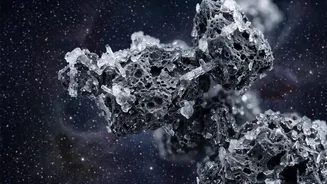
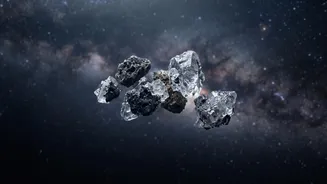
Instead of waiting for a large comet, NASA scientists analysed something much smaller: interplanetary dust particles (IDPs). High-altitude research aircraft collected these microscopic specks—no bigger than grains of smoke—from Earth's stratosphere before they could be contaminated. The team, led by Lindsay Keller, focused on 12 specific particles. They were able to confirm their origin by looking for tiny scars left by solar flare particles. The high density of these tracks proved the dust had spent an immense amount of time in the outer solar system, pointing directly to the Kuiper Belt. Analysis showed these dust grains contained hydrated minerals, like clays, which only form through reactions with water. This was direct evidence that liquid water had once existed on their parent bodies.
A Reservoir of Heavy Water
Here is where the story takes a turn. When the team analysed the oxygen isotopes locked within these minerals, they found a surprise. The water that formed these clays was significantly enriched in heavy oxygen-18—a composition very different from the water found in Earth's oceans. The study provides compelling evidence that a vast reservoir of 'heavy water' exists in the outer solar system, a reservoir that remained largely separate and did not extensively mix with materials from the inner solar system, where Earth formed. This isotopic signature suggests that the ice in the Kuiper Belt formed in a unique environment, under different conditions than the water that now fills our oceans.
Rewriting the Origin of Our Oceans
This finding doesn't completely rule out Kuiper Belt comets as a source of some of Earth’s water, but it makes it highly unlikely that they were the primary contributors. If these distant comets didn't deliver the bulk of our planet's water, what did? The evidence now points more strongly toward another suspect: asteroids. Specifically, water-rich asteroids from the main asteroid belt, located between Mars and Jupiter, are now seen as a more likely candidate for delivering water with the correct isotopic fingerprint. This study powerfully demonstrates how even the smallest particles can hold the biggest secrets. By analysing just a few grains of ancient dust, scientists are redrawing the map of the early solar system and refining the story of how our own blue planet came to be.