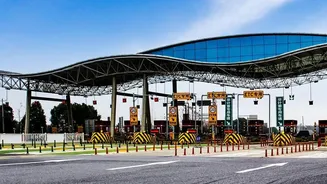









The End of the Toll Booth?
India is progressively moving towards a future with no physical toll booths, aiming to reduce traffic congestion and streamline highway travel. This new model, known as a barrier-free or Multi-Lane Free Flow (MLFF) system, allows vehicles to pass through
tolling points at highway speeds without needing to slow down or stop. The government has begun implementing this on select national highways, with plans for wider adoption. The core technology driving this shift is a combination of the now-familiar FASTag system and Automatic Number Plate Recognition (ANPR), which uses high-resolution cameras to identify vehicles. Together, they create a dual-verification system intended to make toll collection faster and more accurate.
How Your Plate Becomes Your Wallet
In a barrier-free system, overhead gantries are equipped with a suite of technologies. As a vehicle approaches, RFID readers scan the FASTag sticker on the windscreen, which is linked to a prepaid account or bank account for toll deduction. Simultaneously, ANPR cameras, powered by artificial intelligence and Optical Character Recognition (OCR), capture an image of the vehicle's number plate and convert it into digital text. This creates a secondary check; the system verifies that the vehicle's registration number matches the one linked to the FASTag account. This dual system aims to prevent fraud and handle situations where a FASTag is damaged or unreadable. If a tag is missing or has an insufficient balance, the ANPR data can be used to identify the vehicle owner and issue a notice for payment.
A Growing Digital Footprint
While the efficiency gains are clear, the trade-off is a significant increase in data collection. Every time a vehicle passes a tolling point, a digital record is created, capturing the vehicle's registration number, the precise time, and its location. This data is added to the massive National Transport Repository, which already holds records of over 390 million vehicles from the VAHAN database, along with driving licenses and FASTag data. This creates a detailed log of a vehicle's movements over time. The Ministry of Road Transport and Highways (MoRTH) has a policy for sharing this bulk data with both government and private entities, including banks, insurance companies, and research firms, for a fee. Though personal details like the owner's name are sometimes excluded from bulk sales, the potential for tracking and surveillance is substantial.
When the System Makes a Mistake
The accuracy of the data is another major concern. The National Highways Authority of India (NHAI) has itself acknowledged issues with mismatches between the vehicle registration number linked to a FASTag and the actual number plate. This can lead to incorrect toll charges and enforcement actions against the wrong vehicle owner. To address this, NHAI has instructed banks that issue FASTags to validate all vehicle registration data against the official VAHAN database. Accurate data is crucial as the country moves towards more advanced systems where enforcement, such as issuing electronic notices, will be fully automated. Any error in the system could lead to unwarranted penalties and a complicated process for vehicle owners to prove their innocence.
The Road Ahead: Balancing Progress and Privacy
The government is also exploring even more advanced Global Navigation Satellite System (GNSS) based tolling, where an on-board unit in a vehicle would use GPS to track the exact distance travelled on a highway for a 'pay-as-you-use' model. However, these plans have been deferred due to significant privacy concerns raised by experts and parliamentary committees. Officials have stated that a full rollout of satellite-based tolling will only happen once India has its own complete satellite system to ensure data security and avoid reliance on foreign systems. These deliberations highlight the central challenge: how to build modern, efficient infrastructure without creating a pervasive surveillance network. As India's highways become smarter, the need for robust data protection laws that give citizens control over their personal information has never been more urgent.