

The Cosmic Fingerprint of Gravity
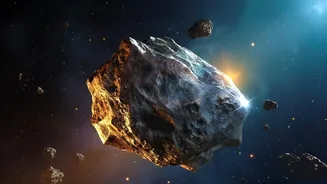
At its core, an orbit is the curved path an object takes as it moves through space under the influence of gravity. Think of it as a constant dance between an object's forward momentum and the gravitational pull of a larger body, like the Sun. Johannes
Kepler first described this motion in the 17th century, noting that planets move in elliptical (oval) orbits, not perfect circles. This fundamental principle applies to everything from planets and moons to the smallest asteroids and comets. By taking several precise measurements of an object's position against the backdrop of distant stars, astronomers can calculate its trajectory. This process involves complex calculations, but the result is a clear picture of the object's path through the solar system.
Reading the Orbital Clues
An orbit provides scientists with several critical pieces of information. The shape of the orbit, known as its eccentricity, tells them how stretched out the path is. A perfect circle has an eccentricity of zero, while a very long, thin oval has an eccentricity closer to one. Objects belonging to our solar system, like planets and most asteroids, follow these closed elliptical paths. Another key clue is the object's velocity. According to Kepler's second law, an object moves fastest when it is closest to the Sun and slows down as it moves farther away. Finally, its inclination—the tilt of its orbit relative to the plane of the planets—can also offer hints about its history and origin. By piecing together these details, scientists can build a comprehensive profile of the celestial visitor.
Rewinding the Celestial Clock
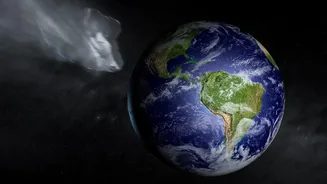
Once astronomers have determined an object's current orbit, they can use powerful computer models to trace its path backward in time. This isn't a simple reversal; the models must account for the gravitational pull of the Sun and all the planets, which constantly nudge and alter the object's course. For objects that have landed on Earth as meteorites, scientists can use photographic records of their atmospheric entry to calculate their original orbits and project them back into space. This technique has allowed them to link many meteorites directly to the asteroid belt between Mars and Jupiter. Similarly, meteor showers are traced back to the debris trails left behind by specific comets on their own orbits around the Sun. This celestial detective work confirms that the orbits hold the key to an object's past.
Is It One of Ours, or From Beyond?
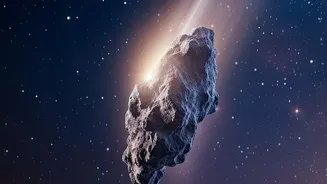
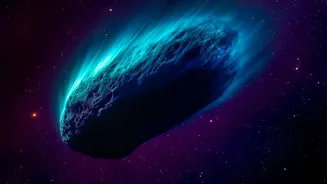
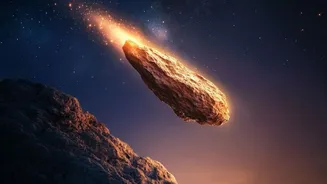
The most exciting application of orbital tracking is distinguishing between objects from our solar system and those arriving from interstellar space. Solar system objects are gravitationally bound to our Sun and follow closed elliptical orbits. They travel fast, but not fast enough to escape the Sun's gravity. Interstellar visitors, however, are just passing through. They arrive on what is called a hyperbolic trajectory—an open-ended path. These objects are moving so fast that the Sun's gravity can bend their path but isn't strong enough to capture them into a closed orbit. After swinging around the Sun, they head back out into the vastness of interstellar space, never to return. The first confirmed interstellar object, 'Oumuamua, was identified in 2017 precisely because its extreme speed and hyperbolic trajectory proved it was not from around here.